• The excitement from Labor Day’s shoot (2012) had barely settled down when another movie crew came to Shelburne Falls to film The Judge, a melodrama set in Indiana.  Mistaking Shelburne Falls for a town in Indiana requires considerable suspension of disbelief, but, as Irving Thalberg told his art director, who complained about using an ocean backdrop for a scene set in Paris, “We can’t cater to a handful of people who know Paris.”  And, in contrast to Labor Day, Shelburne Falls appears in the film a lot as do various nearby locations, including repeated aerial shots of the Mt. Massaemet Fire Tower.  (Two days of shooting at Avery’s General Store in Charlemont seem to have been left on the cutting room floor, however.)

    Not only does The Judge, directed by David Dobkin, include abundant footage from the ‘hood, it’s actually a pretty good movie.  Robert Duvall is superb as the title character, and Robert Downey, Jr. as his smart-ass lawyer son is fun to watch.  The film’s love story never quite rings true, the final court room showdown is the sort of thing that gives melodrama a bad name, the ending is too drawn out, and the evil-city-versus-virtuous-small-town plot premise is both clichéd and dated, but the characters are well-drawn, and Downey’s two on-screen brothers, played by Vince D’Onofrio and Jeremy Strong, are a delight.  Billy Bob Thornton gives a fine performance as the righteous, low-key, out-of-town prosecutor.  In addition to the actors, the writers (Nick Schenk and Bill Dubuque) help to save the film from being just another hackneyed prodigal son story.  Wit and irony not only suffuse the Robert Downey character’s outlook on life but, apparently, the filmmakers' as well, for, in a self-reflexive move, they include one character, the youngest brother, who is a compulsive, amateur filmmaker and also mentally handicapped (in a charming Hollywood kind of way).

    If you’re from Western Massachusetts, be sure to sit through all the final credits, which include the “Shelburne Falls Crew” and gratitude to the people of Shelburne Falls and Buckland.  While the production offices were set up in Shelburne Falls, shooting took place in a number of other Massachusetts towns as well.  IMDb credits Boston as the film’s location, but that is an error, no doubt born of the West Coast assumption that Massachusetts is so small it must all be Boston.  I suspect that in LA one can drive 100 miles and still be in LA (or somewhere similar).  Drive 100 miles from Boston, and if you’re not in a different state entirely, you’re definitely in a different world (although not one that looks anything like Indiana).

    But, seriously, if you love Western Mass, Robert Duvall, or both, go see the film!     

  •  

    Bridge2
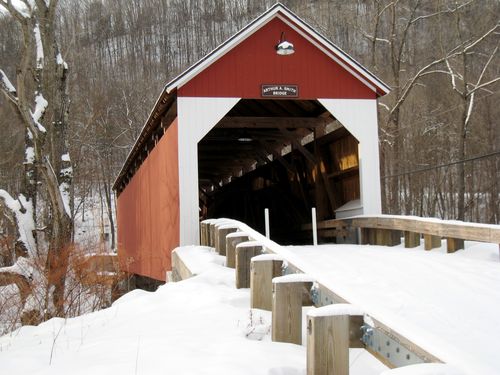
    Arthur A. Smith Bridge, Colrain, MA 


    The Arthur A. Smith Bridge is accessible from Route 112 and Lyonsville Road in Colrain.  Unless on foot, you’ll need to choose one way or the other to go in because the bridge, which spans the North River, is today open only to bicycles and foot traffic.  Named for the Civil War captain on whose land it originally stood, the bridge was built in 1868-70, roofed in the 1890’s, and replaced in 1951.  Added to the National Register of Historic Places in 1983, it was moved, in 1991, onto land adjacent to its present location, presumably to keep it from collapsing into the river.  It stood stranded and derelict for most of 15 years until finally restored in 2005-7.  It survived Hurricane Irene with some damage.  (See http://www.masscoveredbridges.net/gallery/colrain.html.)


  • Mid-June, 2012, had Shelburne Falls and much of the rest of Franklin County all a-gawk as the film crew for Labor Day came to town. For several days, the village of Shelburne Falls became “Holton Mills, New Hampshire,” with principal filming in or in front of many local businesses: Rethreads, Keystone Market, Baker Pharmacy, and the Greenfield Savings Bank, among others. Friday, June 15, was a particularly exciting day as an enormous crane photographed young Gatlin Griffith (Henry) cycling across the Iron Bridge.

    Shooting also occurred in parts of Turners Falls, Millers Falls, Greenfield, and Belchertown. Western Massachusetts seems to have enchanted director Jason Reitman, who called its combination of landscape and architecture “like…in a dream.” (The Recorder, 9/2/12)

    Turners Falls High School film teacher Jonathan Chappell landed a summer job with the film’s “locations department,” which involved scouting and selecting locations, managing them during shooting, and making the necessary arrangements with town boards and property owners.  Since Labor Day was shot digitally, Chappell, who teaches digital filmmaking, was able to observe his craft applied in a big-budget production 

    Folks from Western Mass watching the film will note that Shelburne Falls flies by pretty quickly and many of the landscapes don’t really resemble their part of the state. That’s because much of the film, including Adele’s house, where most of the action takes place, was shot in eastern Massachusetts: Acton, Mansfield, Natick, Medfield, and Medway. (The house is in Acton.) The production company headquartered itself in Natick, and, logistically, it made [dollars and] sense to film close to Natick where possible.

    Unfortunately, the finished film is a bit of a dud.  Jason Reitman, so adept at directing zinging dialogue between gifted teens in Juno, is at a loss directing passion as observed by a mostly mute pre-teen. (Anyone would be, but for this Reitman, who wrote the script, has only himself to blame.) The film’s unlikely premise, a love-starved woman harboring and falling for a fugitive, isn’t new (think the farm episode in Grand Illusion or Heinrich Böll’s Lost Honor of Katharina Blum, adapted to film by Volker Schlöndorff). But to convince us to suspend disbelief, the hunger and the passion have to be visceral, and Labor Day throws in too many complications to succeed in this department. The revelation near the end of Adele’s miscarriages, for example, helps us understand why she seems more catatonic than simply love-starved, but that story element, along with son Henry’s ubiquity, inhibits rather than enhances the passion.

    The narrative’s back story is told mainly through unannounced flashbacks, which are unnecessarily confusing. Considered daring in the 1960’s, such flashbacks have increased in sophistication over the years and often add a touch of mystery, inviting audiences to unravel their meaning, but poor casting choices make those in Labor Day hard to follow, even for inveterate film-goers.

    If the flatness of the story-telling, which picks up somewhat as the couple attempts to put their doomed flight to Canada in motion, hasn’t spoiled the film sufficiently, the ham-handed ending certainly does. Ratcheting through twenty plus years in less than ten minutes, two more incarnations of Henry and a nod to the lasting influence of the memorable Labor Day weekend on him—he excels at making peach pie—we finally arrive at a happy ending; but it’s too little too late—for us and, we suspect, the characters—despite the narrator’s assurance to the contrary.

    For a few days, Labor Day sprinkled pixie dust on Western Massachusetts. Unfortunately, the magic didn’t extend to the big screen. Perhaps the project was too far-flung for Reitman’s talent or, perhaps, his budget. Since 2012, several other productions have shot in Shelburne Falls. Maybe one of these will immortalize the village in film history. Meanwhile, the stars, the excitement, and the recognition will have to suffice.

  • My husband insists that Mill Brook House has returned me to my agrarian roots.  I insist I don’t really have agrarian roots, but compared to growing up in a Brooklyn housing project…yes, okay.  I grew up on the edge of the Michigan State University campus, an agrarian college, in the early 1950’s.  Our neighborhood had been carved from a sizeable farm in the 1920’s, but when the Depression hit, home sales slowed, and there were empty lots even on our block, the first to have been developed.  A veterinarian lived and worked in a tiny old house on the corner across the street and next to the deco-trimmed, brick headquarters of the State Police.  The vet, Dr. Patton, pastured two horses in the field behind his house, and we fed them sugar cubes when we could get them.  (When Patton died, the police bought the property and used it for a parking lot, much to my parents’ relief, for it had been part of a different farm and was zoned commercial.  The police even kept the funny old house intact and over many decades used it for offices.)

    With stay-at-home moms on every corner and the streets behind our house all dead-ends, we enjoyed what amounted to a huge, three-block-square daycare center.  My parents built a stile over our fence so that we could climb from our yard directly into the neighbors’ without having to walk along our own road, which, in the course of time, had turned into a busy commuter route from Lansing to East Lansing.  Each yard had its own delights, swing sets, sand boxes, and plenty of trees to climb in.  It being the 50’s, new construction was everywhere, and no one thought, in those times, to fence it off, so we enjoyed playing on construction sites, finding nails, and walking up and down half-finished stairways to nowhere.  For years small scars remained where I skinned my hands swinging on the naked steel girders of my elementary school's new wing while it was under construction. 

    In time our “territory” extended to include the school, its generous grounds and the surrounding, unused acreage.  There was no fence around the schoolyard, so no one gave much thought to where it ended, other than it was somewhere before the dirt road that ran along the railroad tracks.  We got to school on a path that wandered  past a cornfield and over a creek bordered by woods.  Although we were duly warned at school not to talk to strangers, our parents never supposed our sleepy blocks would attract child molesters, and, as far as I know, they never did.  We lived outdoors from April to the end of October and went barefoot all summer.

    During my early childhood, my parents tended a sizeable garden in the backyard.  I’m told that at one time I had no aversion to tomato worms and happily tore apart the biggest and ugliest of them, but once a fully conscious human being, I developed a horror I retain to this day.  (Slaying seven of them one afternoon last summer left me a nauseous wreck.)  In addition to the vegetable garden, we had raspberry bushes, from which we harvested berries for our morning cereal, rhubarb and a large asparagus patch, a cherry tree, from whose fruit my parents made pies and jam, an apple tree whose blighted apples nevertheless went into applesauce, and black currents, which we children labored in the hot sun to pick so my mother could make jelly.  In addition, we had mulberry trees, which stained our feet and whose fruit we loved to eat.  (Eventually my father cut them down because of the mess they made, a decision that felt like a betrayal!)

    It was the early 50’s and, politically, the country was going through the worst of times, the McCarthy era, which silenced many a professor at MSU who had come of age in the New Deal era.  But none of that filtered down to us.  We knew only that on football Saturdays bumper-to-bumper traffic clogged our road, the cats had to be confined indoors, and trips to town carefully planned to avoid the beginning or end of the game.  From four blocks away, we could hear the roar of the crowd in the MSU stadium, and we loved watching the airplanes that flew above it, dragging advertising banners we could not yet read.

    Nuclear bomb fever also gripped the nation, but just as we didn’t suppose child molesters would be interested in us, so we didn’t expect to be targeted by nuclear warfare.  At school we practiced tornado drills but were never subjected to the idiocy of “duck-and-cover.”  The Cold War was not on our radar.  On the playground, the boys continued to blissfully bomb Tokyo, seemingly unaware that the war with Japan had ended some years before their birth.  When tired of dropping payloads on the “Japs,” they wandered off to catch snakes in nearby fields and admire the powerful new “double-diesel” engines that pulled trains along the tracks behind the school and were slowly replacing steam engines.  (In kindergarten we visited a roundhouse, a place for turning steam engines around so that they could go back the way they came.  I stood dwarfed by the steaming black engine’s giant front wheel, a shiver of fear running through me, but within a few years both the engine and the roundhouse would be obsolete.)

    If not agrarian, it was a pastoral childhood and, despite all that the outside world was doing to itself, an incredibly secure one.  In contrast to adult life, which speeds by in fits and starts of stress and self-doubt, the first six years of childhood last forever.  Garrison Keillor remarked recently that childhood is the only part of our lives that really makes sense.  And so, at sixty-five, my “agrarian” past informs my future.

    Kathe and Sandy in Tree 6
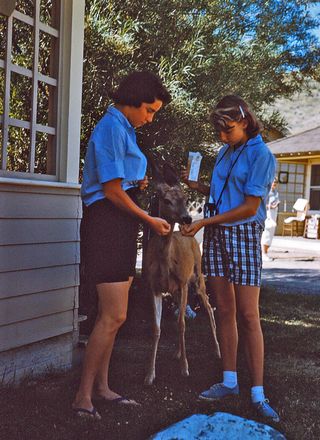
    The author (in overalls) and best friend Sandy in the apple tree


  •           Ornament2011

            Every Christmas at Mill Brook House we bring out our “Christmas movies,” It’s a Wonderful Life and The Shop Around the Corner.  For  some reason we’ve added To Be or Not to Be to the mix, perhaps because, like Shop Around the Corner, it takes place in winter in another Lubitsch-in-Hollywood evocation of an Eastern Europe city (Warsaw). 

             Actually, my favorite Christmas scenes occur in films not strictly devoted to Christmas: who can forget Margaret O’Brien destroying her snow people in Meet Me in St. Louis just after Judy Garland sings a teary Have Yourself a Merry Little Christmas? Although not a Christmas film per se, Meet Me in St. Louis was released just after Thanksgiving in 1944, and Garland crooned more to a war-weary nation waiting for its sons to come home than to Margaret O’Brien: “Someday soon, we all will be together/If the Fates allow. /Until then, we'll have to muddle through somehow.”  Those downer words would later be changed to: “Through the years/We all will be together/If the Fates allow./Hang a shining star upon the highest bough!”  But the original words fit the times.  Within two weeks of the film’s release, the Battle of the Bulge began.  “It ruined our Christmas,” my father, still serving stateside at the time, recalled, citing the sudden increase in War Department telegrams informing neighbors that loved ones had been killed in the offensive. 

        In Jean Renoir’s Grand Illusion, which treats the fragility of love in wartime directly, the lovers, Maréchal and Elsa, first connect over the tiny, table-top Christmas tree and crèche–its Christ Child constructed of potatoes–that Rosenthal and Maréchel have created for Elsa’s daughter Lotte.  These heart-ache-y Christmases, along with the beginning of Empire of the Sun–where the children sing the hauntingly beautiful Suo Gân, followed by the ship-of-fools-like Christmas party in the British Concession of old Shanghai–move me more than the straight-out Christmas films.  But it wouldn’t quite be Christmas without Jimmy Stewart rejoicing with his neighbors in It’s a Wonderful Life or making a fool out of Margaret Sullavan in Shop Around the Corner.  And how could we let a year go by without watching the beautiful Carole Lombard outfoxing both her husband and the Nazis while Jack Benny makes a fool out of himself?  What could accompany the familiar, well-loved ornaments and tinsel on our tree better than these funny, timeless, feel-good gifts from Tinseltown?


  •   Leaves

    Late Autumn is the name of a film by Ozu, who often named his films after seasons: Late Spring, Early Spring, Early Summer (despite being best known for Tokyo Story).  Western culture doesn’t usually draw such fine distinctions between the seasons, but country life has sharpened my sensitivity to the differences between the early, late, and mid of any given season.  Late autumn is a particularly delicate time of year–often gray, an impression heightened (so to speak) by the tall bare deciduous trees all around us.  But within that grayness, muted splashes of color still abound.  Baby trees, with perhaps only a dozen leaves, are bright red or yellow.  Weeds, touched by frost, color up.  The fuzzy, cream-colored tops of goldenrod gone gray nod in the fields and white splashes of milkweed seeds unfurl.  Juncos settle on the fields to enjoy the weed seeds and fly up when startled, darting and tumbling like a gust of leaves in a fall wind.  They, too, are gray with a striking splash of white on their tails, which fan out when they fly.

    With trees and bushes bare, I can better see the contours of the Mill Brook and down into the mini-gorge below the dam: the ancient retaining walls, crumbled cabins, and abandoned machinery, covered in rust and fallen leaves.

    Late autumn brings hunting to Massachusetts, and last year we discovered a refugee in our backyard, a male pheasant unable to find his way past the new fence that cut off the back fields from the front.  He walked up and down the fence, staying close to the gate as if he knew that was the way out if only it would magically open.  He seemed not to think about other options.  He could have flown out or gone back the way he came, but he apparently felt  strongly about walking through the gate.   We watched him for some time, sure he would momentarily take to the air, but he stayed stubbornly by the fence.  Steve grabbed a camera and, coming quite close, photographed him, then took pity and opened the gate.  Magic at last!  Our bird strode through the opening and only then took flight.

    Pheasant3
     

  • Not being either a school teacher, mother or grandmother,
    my familiarity with children’s books written after the 1960’s is sketchy at
    best, although I did read the entire Harry Potter series.  I was inspired to do a little catching
    up when author Sheila O’Connor stayed with us this past summer, and, later in
    the summer, The [Greenfield] Recorder ran a story about a new
    children’s book involving a Civil War vet buried in Greenfield.  

    Sheila O’Connor,  Sparrow
    Road

    Like O’Connor’s award-winning adult novel, Where No Gods Came, Sparrow Road is a meditation on absent or delinquent parents and a
    child’s inner strength and ability to cope in the face of such loss.  Sparrow
    Road
    , named for the novel’s erstwhile orphanage-turned-artist-colony, is
    also a celebration of the arts as a means of both communication and healing, a
    joy comparable to the lovely nature that surrounds the residents of Sparrow
    Road.  Everyone at Sparrow Road has
    an art, even the long-departed orphan Lyman, whom the book’s protagonist Raine
    reconstructs in her heart.  Like
    the author, Raine discovers her art to be writing, as she delves into Lyman’s
    story.  Through Raine and her
    artist friends, Josie and Diego, O’Connor suggests that we all have some art
    within us that can help to heal our hearts if we spend enough quiet time listening
    and opening up to it.

    Sheila O’Connor,  Keeping
    Safe the Stars

    In her second novel for children, O’Connor takes greater
    risks than in Sparrow Road, creating
    an eccentric trio of orphans who attempt to live on their own when their
    grandfather guardian, Old Finn, suddenly succumbs to a serious illness.  Unlike her other bookish, intelligent,
    scribbling heroines, O’Connor creates a Willa-Cather-esque character in her sturdy,
    independent narrator Kathleen Star (“Pride”), who prefers handiwork to academics.  The book explores in poignant detail the
    gap between a child’s limited understanding of the world and adult reality.  As in O'Connor's other novels, Keeping Safe the Stars deals with
    children who strive to keep family intact against a current of adults who are,
    in some combination, absent, ill, dysfunctional, or irresponsible.

             While
    children’s literature is littered with orphans, the better to create an
    unfettered, independent young person who can have adventures, O’Connor’s work
    seizes on the real agony and desperation of children cut off from the adults
    who should love and care for them. 
    The strong meat of Where No Gods
    Came
    , an adult novel, is tempered in the children’s books, but O’Connor
    pushes the envelope further in Keeping
    Safe the Stars
    than in Sparrow Road,
    provoking real discomfort in the reader as the children’s plight worsens until
    they finally hatch a plot to find the one adult who can help them.

    Nancy Bestuhl,  The
    Mystery of the Lost Canteen

    This story is based on a wooden Confederate canteen,
    recovered and decorated by one Charles Ulrich, who served first with the 25th
    Connecticut Volunteers and later became one of the white officers who led all-black
    regiments (like the Massachusetts 54th, subject of the film Glory).  Beginning in 1864, Ulrich led the 31st USCI (United
    States Colored Infantry).  Ulrich’s
    family moved to Greenfield when he was a teen, and his body was returned to
    Greenfield when he died in 1902.

        Nancy Bestuhl’s husband found the canteen in his house in
    Virginia in 1950.  No one knows how
    it got there, but it obviously intrigued the author, a former school teacher,
    and her husband, so she wrote a story in which the canteen is found by a boy,
    Jimmy, in 2009.  The canteen serves
    as a kind of portal, and  Jimmy
    travels in time back to the Battle of Port Huron on the Mississippi River, the
    place Ulrich apparently found the canteen.  Jimmy meets Charles Ulrich and learns first hand the horrors
    of war, particularly as fought in 1863.

        The story seems, in many ways, superficial and simplistic,
    although the details of the battles are quite realistic, and, at the end, Jimmy
    meets a descendant of one of Ulrich’s black infantrymen.  The book’s high point comes when, halfway
    through, Jimmy helps Ulrich blow up a Confederate ammo dump and take several
    enemy soldiers prisoner.


  •  

    Nellie3c
                                                                                                                  copyright Steven Sternbach

    We were considering names.  “How about Nellie Fox?”  Steve suggested as we sat on a log having lunch, hoping not
    to be shot by one of deer rifles echoing from the  New Hampshire woods behind us. 

                “That’s
    brilliant!” I replied.  “Who’s
    Nellie Fox?”  We were en route to
    view a newborn Shiba Inu puppy, the only girl in a litter of six, (and along the way, we were forming a
    decidedly scary view of the wilds in which she had been born.)  Steve explained that Nellie [Jacob
    Nelson] Fox had been a second basemen for the Chicago White Sox in the 1950’s.  Fox, a 12-time All Star, had died relatively
    young, and for years a Nellie Fox fan club had tried to get him inducted into
    the Hall of Fame.  In 1997, his
    last year of eligibility, they succeeded, but that’s getting ahead of my story.

                The
    puppy fit into one of my hands.  
    We paid a deposit and returned seven weeks later to collect her.  Pam, the breeder, forgot we were coming
    and greeted us with a pointed rifle, reinforcing our skeptical view the neighborhood.  “She bit her brother,” Pam announced,
    as I wrote out a check.  Right
    then, we should have reconsidered. 
    The bundle of less-than-happy fur we were about to collect—she panted
    from fear all the way home—was a fighter, and not a very wise one.  For one thing, she never grew to be
    more than half the size of a normal Shiba and had absolutely no sense about
    what she could take on.  Exploring
    some odd sounds at our otherwise empty campground one night in 2004, I looked down
    to see her standing on her hind legs, straining on her leash, and beating the
    air with her paws in an effort to get at what I soon realized was a bear the
    size of a Volkswagen. 

               For her first year Nellie played
    happily in the dog park across the street, but when it closed for renovations, any
    hope that she might get along with other dogs closed with it.  Even as a puppy, she responded fiercely
    to anything she perceived as an affront to her sovereignty—a big dog running
    over her, for example—and soon lost the ability to distinguish play from
    fighting.  She didn’t like being
    touched, not by dogs and not by humans. 
    We had to teach her to enjoy being petted, and she never got used to
    being brushed.  I brushed her fur
    and her teeth almost every week for 17 years, and she screamed and struggled
    and threatened to bite every one of those 884 weeks!  Fortunately, she was not usually aggressive, unless
    provoked, and eventually developed a Garbo-esque desire to simply be left
    alone, at least by strangers.

    Nellie28aa

                She
    was breed-conscious and had an uncanny ability to recognize dogs that were like
    her: Huskies, Akitas, other Shibas, and so on.  She was drawn to them, even if a fight was likely to ensue, and
    as a puppy she fell in love with Jason, a handsome, laid-back dude, tannish-white
    and part Norwegian elkhound.  She
    met him during our dog-park year, and long after the park was closed and she
    lost her ability to play with other dogs, she greeted Jason with spasms of joy.

                If
    she didn’t like the usual rough and tumble of the dog park, she loved  running. Whenever possible, she encouraged dogs to chase
    her, and she was so fast that few could catch her.  Once during our dog-park year, a young German shepherd took
    off after her and fell far enough behind that he found it necessary to “cheat”
    by jumping over a low bench in order to shorten the distance between them.  Sometimes, with no one to chase her,
    she would take off in mad circles, running round and round until exhausted.  Frisbee was another pleasure that found
    her running back and forth under the flying disks.

                Obedience
    eluded her.  Shibas are an
    atavistic breed, descended, or so the Japanese claim, from pre-history.  I once read an article on Carolina
    dogs, believed to be descended from dogs that accompanied the earliest
    immigrants over the landmass that once bridged the Bering Strait, and I found
    descriptions of their idiosyncrasies similar to Nellie’s—the sudden, frantic, spontaneous
    digging of small holes, for example. 
    Nellie’s whole life was one long compromise, trying to conform her
    wildness to domestic life.  It
    wasn’t that she never learned to “come,” she militantly refused to learn to
    come.  Following my dog book, I
    tried treats and a training leash. 
    As long as the leash was on, she “came” for the treat, but as soon as it
    was off, she weighed the treat against freedom and opted for freedom.  Steve and I spent a great deal of her
    life involuntarily chasing her, and she loved every minute!  She wasn’t dumb, but she used her
    smarts in the interest of staying wild instead of becoming domesticated.  Once on the Cape’s Marconi dunes, when
    I dropped her leash, thinking she would run to “Daddy,” she darted under the
    fence instead, running round and round the protected dune where we couldn’t
    follow.  We watched helplessly
    until finally Steve was able to grab her leash as she cruised close to the
    fence for the fifteenth time.  She
    loved us, and she never wanted to run “away” exactly; she just wanted to be
    free.

                So
    how was it we came to love this dog like our very life?  For starters, she was, by all objective
    standards, incredibly beautiful. 
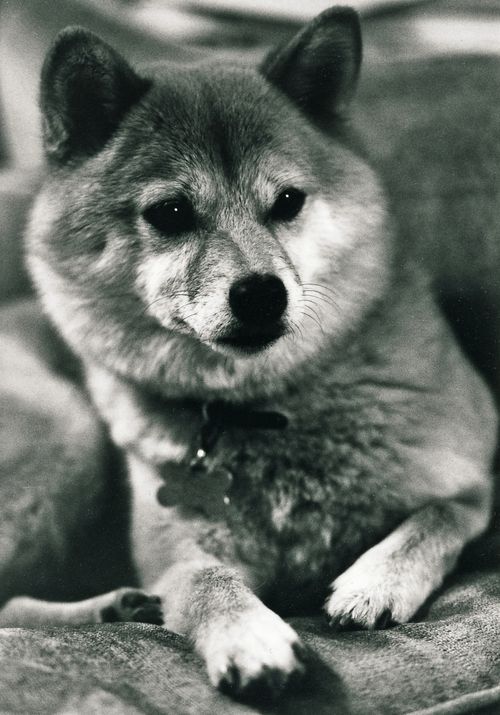
    Descended on her father’s side from two of Richard Tomita’s original Shibas
    from Japan, she bore a strong resemblance to “Chibi,” the cover dog on Tomita’s
    Shibas book, whose thick soft fur, rounded features, and soulful eyes
    made him particularly handsome. 
    Those features and her small size gave Nellie a perpetual puppy
    look.  Up to a few months before
    she died, people were still stopping us to ask if she were fully grown. (Our
    local bookstore featured an amazingly cute picture of her at six months in
    their 1996 fall newsletter.)

    Booksmithnewsletter2

                Steve
    summed it up best when he looked at her one day and said, “If you weren’t so
    cute, you’d just be a bad dog!”  She
    beguiled with her actions as well as her looks.  Steve’s father called her a little “vance” (mischievous
    child), and she mortified his mother when, on her first visit to their high
    rise Brooklyn apartment, she dove under the sofa, a space two inches high, to emerge
    minutes later with a desiccated  mouse!
     My sister, impatient with Nellie’s
    waywardness, shook with  helpless laughter one night as she
    watched her chase June bugs on our deck.  For better or worse, Shibas have an amazing range of vocalizations, so I taught
    her to sing.  She frequently serenaded
    us, hoping for a treat, and always accompanied us on “Happy Birthday,” her
    favorite song because birthdays meant presents.  She could never quite understand that not every birthday was
    hers and always looked forward to opening presents, no matter whose.  She paced around the Christmas tree on
    Christmas Eve as impatient as any child to start opening her gifts. 

    Nellie20aa

           She
    played hard, indoors and out.  She
    could pluck balls from mid-air and would do handstands to field grounders.  Passers-by stopped to watch her play “soccer” in the park, chasing a beach ball around, pushing it with her nose like a seal, while we ran
    in and kicked it away from her. 
    She had a variety of indoor toys for chasing and chewing, but
    particularly loved tug-of-war with her rope toy, standing on her hind legs to
    wrestle it away from Steve in a pose we dubbed “Tyrannosaurus Fox.”

           Although
    she was almost nine when we purchased Mill Brook House, she had many good years
    there, running through the fields, chasing turkeys, hunting for mice, and fishing
    for leaves as they floated down the Mill Brook.  We built her a pen from the sturdy fence that had surrounded
    the defunct swimming pool we filled in, so she could spend time lolling in the
    sunshine and chasing bugs. 
    Although we tossed balls for her both outside and inside the pen, she
    came, in her last years, to distrust the open fields—too many smells from
    animals she knew she could no longer defend herself against—and to prefer the
    security of her pen.  As she aged,
    the pen became the last place I could get her to play ball.  When Hurricane Irene destroyed it in
    the late summer of 2011, she never chased balls again.  Becoming ever more fragile and
    dependent, she left us a few days after Christmas in 2012, bequeathing
    indelible memories of a charming, difficult, unique little personality.

     

    Nellundertree
    Good night, little Princess…


    For more photographs of Nellie Fox, click on the album in our sidebar "Nellie Fox in Pictures" or use this link: http://www.millbrookhousenews.com/photos/nellie_fox_in_pictures/index.html
  • Bruce Watson's Freedom Summer

    In the summer of 1967, I went to Holly Springs, Mississippi with a group of students from Michigan State to conduct a summer workshop for incoming freshman at Rust College, an historic black college, which had lost its accreditation because of low academic standards.  Products of segregated schools, Rust students had few academic skills when they entered, giving their teachers little to build on.  A remedial program intended to give freshman a leg up in reading and math, the 6-week summer workshop was intended to help the college raise standards and regain accreditation.  (Such remedial programs, ubiquitous on college campuses today, were more or less unheard of in 1967, when college classrooms overflowed with more baby boomers than they could handle.)

    Before leaving for Mississippi, veterans of the program schooled us in how to behave, both off and on campus, to avoid either stirring up trouble with white Mississippians or breaking the rigid rules of our host college.  Rust strictly forbade any form of PDA—public display of affection—no matter what color or combination of colors the couple.  Frankly, this worried us more than the threat of violence, but we heard stories of “varmint guns” carried in the backs of pickup trucks and knew, in a general way, of violence throughout the South, targeting civil rights workers.  Although heinous race-based crimes had continued to occur in Mississippi through 1966, the state had, by 1967, settled down considerably since the infamous summer of 1964, when three young men were abducted and murdered, and the state was gripped by a veritable guerilla war.  In Freedom Summer, fellow Franklin County resident Bruce Watson documents that war and, to a lesser extent, its aftermath, the relatively peaceful Mississippi that I encountered. 

    Mississippi in 1964 was considered so violently racist that even Martin Luther King avoided it, preferring to stage his actions in his home state of Alabama.  Taming Mississippi was left to SNCC (the Student Nonviolent Coordinating Committee). “Freedom Summer,” which, working out of Freedom Houses throughout the state, spearheaded voter registration drives and established consciousness-raising Freedom Schools, was the brainchild of Robert Parris Moses, SNCC’s field secretary.  Volunteers were recruited from college campuses across the country.  In the end about 300 young people, most under 25, participated in Freedom Summer, half of them Northern, relatively privileged, and mainly white; the others members of Misissippi’s chapter of SNCC, veterans of shootings, beatings and Southern apartheid.

    On the first day of the project, three of the workers, Andrew Goodman, James Chaney and Michael Schwerner, were murdered by Klan members, the county sheriff among them.  It would take the rest of the summer for the FBI to locate their bodies and issue indictments.  Watson’s narrative jumps skillfully between the FBI search and the events and achievements of Freedom Summer, using the stories of four volunteers from the North, one black, three white, two men and two women, to give a face to the narrative and tie it together.  Most poignant is the story of shy Fran O’Brien, who spent the summer teaching young children in a Freedom School, only to be abducted and beaten by Klansmen at the end of the summer.  At one point, Fran asks her young pupils to name the countries from which Americans had come.  The children begin with European countries and move on to China and India when Fran finally asks them “What about Africa?”  “Does that count?” they ask her dubiously.

    Threats and violence came non-stop.  Highly organized, Freedom Summer volunteers kept in touch via a WATS line (precursor to 800 numbers) and wrote up logs, which recorded each incident.  Page 7 in one log leads off with a familiar name: “Holly Springs: … Threats of dynamiting Freedom House tonight.  Guys driving around with guns….” 

    Celebrities came to Mississippi, some to entertain, some to volunteer, among them actress and activist Shirley MacLaine, as well as Richard Beymer, star of the film version of West Side Story, who worked alongside [my congressman] Barney Frank, a Harvard student at the time.  “I am prouder of being there than of anything else in my life,” Frank has said.  Harry Belafonte, along with a terrified Sidney Poitier, delivered $60,000 in cash to bankroll Freedom Summer’s final project, sending an all-black delegation to the Democratic National Convention.  Fannie Lou Hamer, activist from Ruleville, Mississippi, would become a celebrity (although never a wealthy one) because of that convention.

    In the years after Freedom Summer, Mississippians came to be embarrassed by their singular status as the most racist state in America and, according to Watson, worked hard to modify that image.  Already in 1967, I found Rust students quick to tell me that Mississippi was bad, but Alabama was worse!

    So many years after and with later generations of young people famous for their apathy and/or incubation of cynical right-wing extremists like Jack Abramoff, Karl Rove, and Grover Norquist, one wonders why so many were willing to risk their lives in Freedom Rides, Freedom Summer, and other aspects of the Movement.  One answer is that the children of the 40’s and 50’s grew up acutely conscious that their parents had fought and sacrificed to win a momentous victory over fascism abroad.  They could do no less than fight it at home.  And then there was the martyred president, who had admonished them to “pay any price, bear any burden, meet any hardship … to assure the survival and success of liberty.”  Kennedy himself was taken aback when young people applied his words almost immediately to the Civil Rights struggle, but once spoken, they inspired a generation to fight the battles their elders would not fight.  


  •     Every Thanksgiving and Christmas, when our garden is frozen
    and we have more time to be in town, we try to catch up with a few movies at
    the Greenfield Garden Cinema.  This
    year we caught Spielberg’s Lincoln on
    the Sunday before Christmas and enjoyed it, especially the acting.  Critics have heaped praise on Daniel
    Day-Lewis for his amazing portrayal of Lincoln, but all of the acting was
    superb.  Who would recognize Sally
    “You-Really-Like-Me” Field as the terse Mary Todd Lincoln?  Awards have also been rightly heaped on
    Tommy Lee Jones for his performance as Thaddeus Stevens (who, by the way,
    really did have a 23-year liaison with his “quadroon” [one quarter black] housekeeper).  James Spader, Hal Holbrook, and David
    Strathairn gave outstanding performances as did the less well-known actors.  Janusz Kaminski’s award-winning low-light
    cinematography, capturing the era in the sepia tones we associate with wood,
    candles, and early photography, is also treat. 

        The film’s story-telling (script and
    editing) is uneven, however, and often leaves the audience, at least this
    audience, squirming with embarrassment. 
    Spielberg has never known when to end his films and has ruined many a
    good one (The Color Purple, Empire of the Sun, Schindler’s List, for example) with too many endings, and Lincoln is no different.  We do not need to be walked through the
    assassination, his cabinet gathered round the crumpled body, or flashback to
    his Second Inaugural.  Lincoln
    descending the White House stairs on his way to the theater, framed by the dark
    arch of the portico, would have been enough.  The rest, as they say, is history.  (Steve bought me Sunrise
    at Campobello
    on DVD for
    Christmas.  As Ralph Bellamy’s Roosevelt
    begins his speech nominating Al Smith at the 1924 Democratic Convention, the
    culmination of a three-year struggle to find a life after polio, the camera
    pulls back amid confetti, balloons, and cheers.  We know the rest of the story.  Spielberg should have studied his prototypes better!)

        Unfortunately for this film, not
    only the end but the beginning is mishandled with two soldiers, one black, one
    white, telling Lincoln of their exploits on the battlefield and reciting the
    Gettysburg Address for him.  It
    doesn’t get more embarrassingly didactic than that.  I once published an article on “Old Age Cinema,” in which I
    discussed the characteristics that I thought films created by directors in
    their later years had in common. 
    As Lincoln started out, I
    wondered if Spielberg was falling into that category, and not in a good way,
    but the core of the film, the fight for the 13th Amendment, was as
    tight, lively, and irreverent as anything Spielberg or anyone else, for that
    matter, has made.   That and
    the acting are worth the price of admission.