• The one-year anniversary of Hurricane Irene
    came and went, and I tried not to notice. 
    Grass has grown back, as best it could, given the drought.  The garden is re-established, still lacking
    many perennials but with improved soil and design; we have added a second
    garden, especially for daylilies.  We
    love the broad, mow-able path down to the brook that Jonathan, our landscaper, created out of
    the tangle of rocks, trees, and eroded soil the storm left.  We still miss our secure dog
    pen—created from the fence around the defunct swimming pool that became my
    garden—but we’re managing with enough fencing to keep the dog off the
    road.  With the constant labor
    these improvements have required, my sense of trauma has receded.

             But
    all disasters, natural and man-made, leave silences.  For us the sights, sounds, and, yes, smells of the goat farm
    are an echoing absence.  I stand
    long on the bridge by the former farm. 
    2004 (the year we bought Mill
    Brook House) is carved into it.  I
    can remember the construction and how we first visited the farm, using a
    temporary bridge to cross the brook. 
    John and his aunt had owned it only a year and welcomed more newcomers.  We admired the goats and the single
    Jersey cow.  I was glowing with
    excitement over our new adventure. 
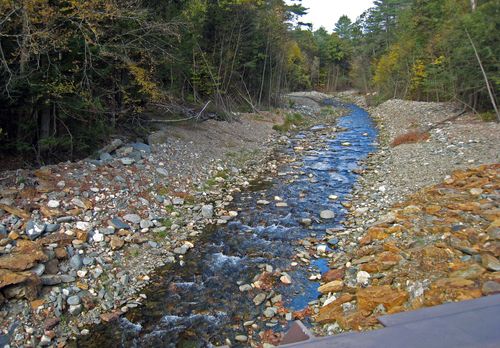
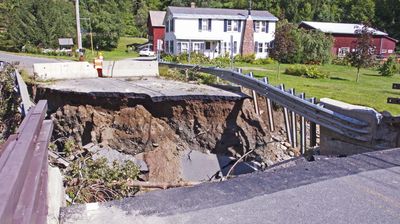
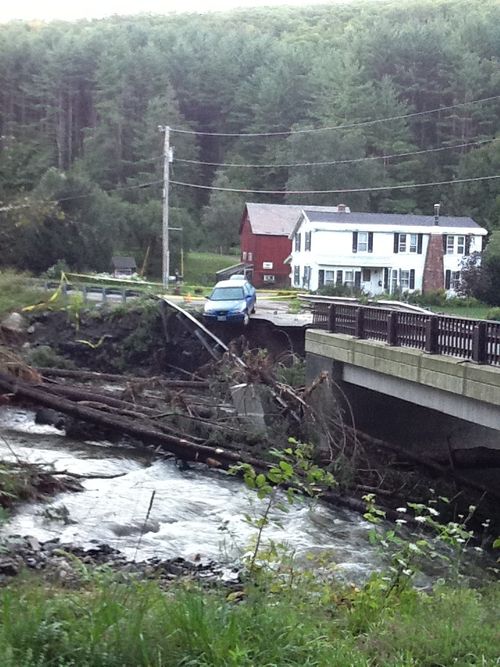
    Hard to believe that seven years later the bridge would split apart and
    leave a car dangling over the edge of the ravine.*  I stare at the empty farm. A family lives there, but they do
    not keep animals.  Across the
    street the homeowner has purchased four donkeys, one pregnant, as pets.  They are shy and often prefer their pen
    to the narrow field along the road that she has fenced off for them, but they alleviate
    the silence.

         I
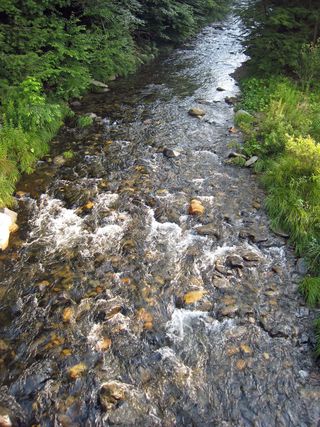
    return some weeks later to take pictures of the reconstructed brook, and then I
    hear it: a rooster crowing.  I look
    at the farm, and there are chickens in the coop and baby goats in the pasture.  As if a paintbrush wielded by Disney
    were filling them in, the animals are reappearing.  A week later a duck appears and sheep.  New folks, oh my! 

    MB.MtnRd
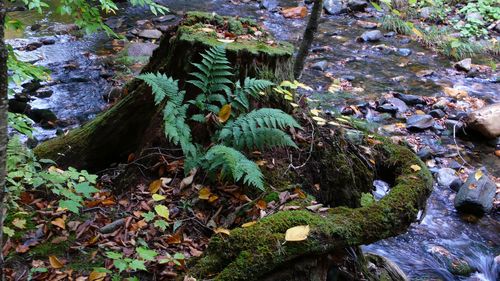
    The Mill Brook at Mountain Road before the hurricane

    Bridge2
    The bridge at Mountain Road after Hurricane Irene


    MBafter
    The Mill Brook at Mountain Road today

    *A picture of the car hanging off a collapsed
    Mountain Road, which we included in our blog entry “Good Night, Irene,” was
    published three (!) times—once in reverse on the back cover—in the recent book of
    the same name, Good Night Irene, by
    Craig Brandon, Nicole Garman, and Michael Ryan.  The book details the stories and destruction from eight
    locations in New York, Massachusetts, and Vermont (mostly Vermont).  About 25 pages are devoted to the Deerfield
    Valley from Williamstown to Greenfield, with several pages and pictures covering
    Charlemont.

    Donkey

  •  

    RJG2

    On a recent visit to Mill Brook House, my sister asked if I remembered eating in our dinette when we were kids.  From the 1920’s-1940’s dinettes, small alcoves with a built-in table and benches, made smaller more efficient kitchens possible.  Ours was generally packed with no fewer than five people, my mother presiding over the meal from a stool at the end of the table, my father in the corner, pressed against the window—the better to observe his bird feeders—instructing us in all that interested him.  “Of course,” I exclaimed, “I learned everything I know about history and politics in that dinette!”  Well, not everything.  I went on to earn a history minor and a Ph.D. in art history, but in that cramped space my mind expanded as it absorbed my father’s most dearly held beliefs: Hitler was bad, the New Deal was good, Roosevelt was practically a god, World War II a noble cause, and racism, red-baiting, Republicans and Joseph McCarthy all bad.  Republicans were bad only if they held office; otherwise they were merely misguided, and he stated his reasons simply: their policies made the rich richer and the poor poorer.  He had no use for political independents either because, he insisted, organization was the only way to get things done.  In one discussion he noted that the Depression had also made the rich richer and the poor poorer.  Though young, I was fully engaged and reminded him that, according to his own accounts, the Great Depression had made everyone poorer.  No, he countered, the very rich had gotten richer.  (Who, experiencing our own Great Depression, can doubt the wisdom of that insight?)

             Appropriately, my father shares his centennial with Fenway Park and Woody Guthrie.  He was an avid baseball fan at a time when sports enthusiasm was considered dĂ©classĂ© among intellectuals and academics, and, if he could never really relate to “Woody’s children,” the leftie balladeers of the 1960’s, he appreciated the original as well as the tragic severity of the Dust Bowl Woody emerged from.  Musically challenged, he nevertheless collected the work of Odetta, Lead Belly, and Burl Ives.  Only later in my life did I understand them as precursors to my beloved folkies of the 60’s.

             Although my father died well before I married and almost 20 years before we bought Mill Brook House, we feel his influence here.  An intermittent gardener, he enjoyed tending plants, and when I was small, he and my mother gardened seriously in an attempt to save money on food bills, a challenge I’ve taken up at Mill Brook House (with mixed results).  He began his academic career in Cornell’s School of Natural Resources, specializing in ornithology.  Although he would switch to English for his Ph.D., he never lost his love of birds, one of our special delights at Mill Brook House. 

             Beyond these enthusiasms, another of my father’s enduring legacies was his great respect for neighbors.  Shy and academic, he found small talk difficult, even painful, but he always maintained a special relationship with our neighbors, befriending them, supporting them when needed, and cooperating on numerous projects with them.  The value he placed on neighbors was different from my mother’s all-purpose gregariousness; it carried a moral force. 

             When we moved to Mill Brook House, I made a point of meeting and greeting all our neighbors up and down the road.  On Christmas Eve I left treats at every door.  I understood instinctively that for second-home owners, especially, neighbors are a lifeline, as Hurricane Irene would prove, and this, at least in part, because my father had taught me early on that neighbors constitute a special class of friend.          


  • Tanglewood2 copy  

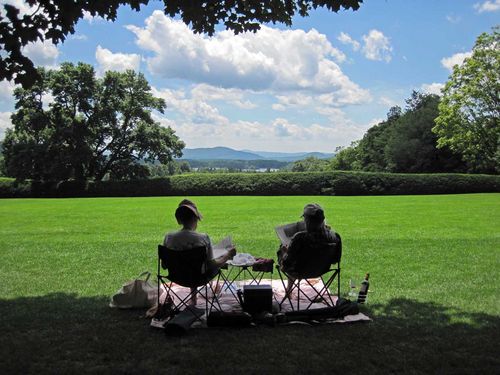
    For the first time since we bought the house, we made what used to be our annual trek to Tanglewood.  Armed with eggs (boiled) and cheese from Goat Rising and bread and muffins from the Country Store, we headed southwest to the music camp.  Arriving around 10:30, we found a shady spot for the car and spread out our brunch under the trees in the parking lot.  The gates opened at noon, and soon after we went in and toured the lovely grounds outside the Koussevitsky Shed.  The program was, uncharacteristically, a Pops concert, featuring Alec Baldwin and Arlo Guthrie.  We, uncharacteristically, had seats inside so that we could see them both.  Baldwin read excerpts from Kennedy brothers’ speeches, and Arlo was, characteristically, Arlo.

    I have never encouraged people with Tanglewood on their mind to stay with us, and if that is the only destination, there are closer places for rent.  But for anyone staying with us a week or two, Tanglewood should make the short list of day trips.  The ride, alongside lakes and streams through pleasant countryside and forests, takes about an hour. 

    From Charlemont, take Route 2 through town to 8A South.  Turn left and travel for about 10 miles.  Turn right when 8A joins 116 and left when 8A leaves 116 to continue south.  When 8A ends at Route 9, turn right and follow 9 into and through Pittsfield until it joins Route 7.  Follow 7 south to 7A in Lenox and turn right on 183.  You’ll see signs for Tanglewood.  

    If you’re traveling with a dog, seek out the wooded section at the far end of the East Parking Lot.  Arrive before 11:30 and tell the parking lot attendant you want to park in the shade.  At that hour, you’ll have your choice of spots.  Pick out the most densely covered, and your dog will be fine throughout the concert.  We always check on ours during intermission, and this time found her so fast asleep she didn’t know we’d come and gone.

     For tickets and box office hours, go to tanglewood.org.

    Tanglewood1 copy1

    (photos courtesy Steven Sternbach)  


  • Moca Outside

    True confession: I dragged my feet getting to MassMoCA.  After six years in the Berkshires and numerous trips to North Adams, we finally made it there January 1, 2011.  I’d never been a fan of contemporary art, even though this was ostensibly the area of my Ph.D.  But as a medievalist-turned-film-historian, I was much less interested in contemporary plastic arts than celluloid ones–film was still on celluloid back then–less interested in philosophical/theoretical meditations, than theological/humanist ones.  MassMoCA, however, awoke my dormant medievalist and turned me into a believer.

    It starts with the building.  As much a monument to an era of faith—faith in industry, the American worker, and the rivers tumbling out of the mountains of the Northeast—as a Gothic cathedral, as huge, awe-inspiring, and archaic, the rugged old mill buildings that house MassMoCA are as present as the art they house.  Built between 1860 and 1890 for the textile firm Arnold Print Works, the buildings were purchased in 1942 by the Sprague Electric Company, a major R&D firm that made electric components until overseas competition drove it out of business.  Their cavernous spaces are ideal for monumental installations that mingle with rough brickwork, vaults and arches, high windows, and heavy wooden beams from a bye-gone era.

    Moca Interior

    Purchased for a museum in 1986, the site didn't open until 1999 as its founders dealt with on-going funding difficulties.  Since opening with 208,000 square feet of renovated space, the 13-acre campus has doubled and now includes a concert hall, artist workspace, office and retail space, as well as its 110,000 square feet of installation exhibit space. Unless an artist aspires, Christo-like, to complement nature, only his or her imagination limits what can be displayed here.

    Among the most arresting works we saw were Orly Genger’s miles of intricately knotted, orange rope that burst through one wall and lay in piles in an adjoining room and Katharina Grosse’s enormous icebergs of Styrofoam and brightly colored earth.

    Orly Genger
    Orly Genger, Big Boss, 2009-10

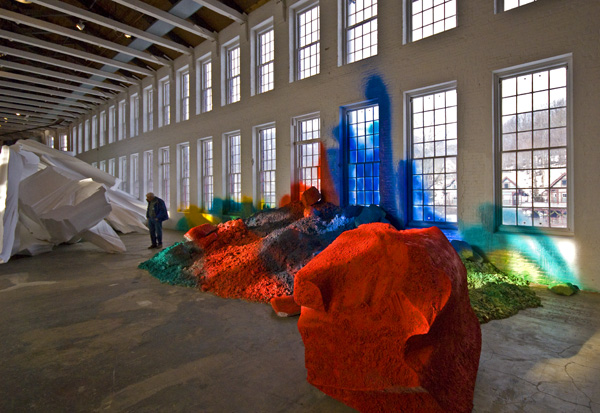
    Mounded up in front of two stories of huge windows, its spray-painted primary colors straying onto several of them, Grosse’s installation, indeed, reminds one of a cathedral. 

    Grossman Katharina Grosse, One Floor Up More Highly, 2010 

    Evoking both the subject matter and aura of 17th century still lifes, particularly dark Spanish ones, Petah Coyne filled one windowless room with islands and hanging orbs of dark flowers, decorated with stuffed birds and animals, an installation that, eerie and claustrophobic, was disturbingly beautiful.

    Birds
    Petah Coyne, Everything that Rises Must Converge, 2010 

    Of the installations we saw, only Frederico Diaz’s cascades of black balls, arranged near the museum’s entrance, remains, but only until March.

    Diaz Frederico Diaz, Geometric Death Frequency–141, 2010

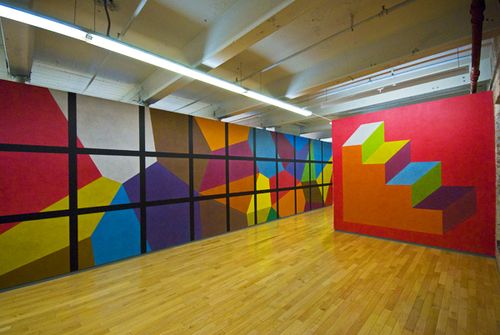
    A retrospective of conceptual artist Sol LeWitt’s wall drawings occupies one entire three-story building.  From 1968 to his death in 2007, LeWitt created mathematically-based line configurations for wall drawings that were subsequently painted on real walls by a team of assistants.  Conceived in 2003 in cooperation with LeWitt and his wife, work on the MassMoCA project began in 2007 with three LeWitt assistants directing a team of 62 artists, who filled walls erected in the 27,000 foot interior of “Building #7.”  The exhibit moves chronologically and vertically through LeWitt’s work with the 1960’s and 70’s on the first floor, the 80’s and 90’s on the second floor, and the incredibly colorful and exuberant work of the late 1990’s to 2007 on the third floor.

    Mass Moca 112a

    Mass Moca 2b
     
      Mass Moca5b  Sol LeWitt, A Wall Drawing Retrospective

    Mindful of his wall-painting predecessors, LeWitt once said, “I would like to produce something that I would not be ashamed to show Giotto.”  My inner medievalist says that he has.  The exhibit will be on display for the next 25 years, but don’t wait for the last day to see it!

    For more images of the MassMoCA exhibits from 2010, click on our MassMoCA photo album in the column on the right side of this blog or use this link: http://www.millbrookhousenews.com/photos/Art/ 

    For information on current exhibits, see massmoca.org.


  • Daffs2

    Flower by flower, Mill Brook House is coming back.  There are bluebirds in the birdhouses, yellow-bellied sapsuckers tapping up a storm in the woods, and a great blue heron is frequenting the Irene-enlarged stream that runs behind the house.  Having channeled the entire Mill Brook for one week, the stream is now large enough to support thumb-sized minnows that interest the heron.  Frogs, silenced by the cold snap after the March heat wave, will be calling and singing again soon. 
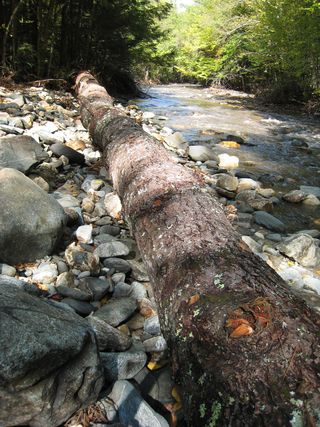
    Log


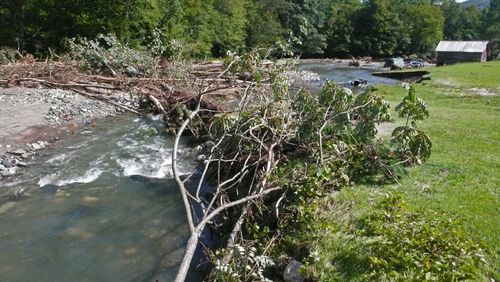
    A giant log swept in by the storm and lodged against one bank of the Mill Brook, where it runs through our land.


    It has been an arduous and sometimes frustrating road to recovery, but we are almost there.  All of our systems had to be rebuilt or replaced, work that was finally complete by Christmas 2011.  Our humble thanks to the diligent tradesmen who persisted until everything was working again.  Thanks, too, to our neighbor Ian, who had the good sense to tie our propane tank to the deck, lest it join hundreds of other tanks washed down the Deerfield in the storm.  Sadly, our secure dog pen, which took the full force of the flood, was completely destroyed.

    Jonathanworking

    Clearing sand and debris, front and back, so that our garden and driveway could be restored took most of the fall.  We continue to work on resurrecting the garden, the lawns and the meadows and removing flotsam from the woods.


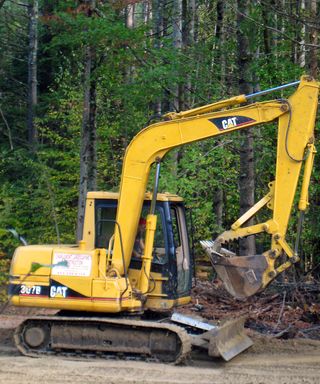
    Jonathan Winfisky clears sand from the backyard.  Jonathan runs heavy equipment in the summer and blows glass in the winter. 


    Living with our cheerless landscape through the fall and snowless winter was depressing, but with spring’s renewal finally here, each survivor that pokes its head up in the garden, each new blade of grass—even the garden’s unwanted grass, which we carefully remove and plant elsewhere—and every returning bird bring enormous joy.  Mill Brook House is coming back!

    We will be ready for guests on June 1.  For prices and availability, please check our listing at: http://www.homeaway.com/vacation-rental/p144555 .


    Barrel
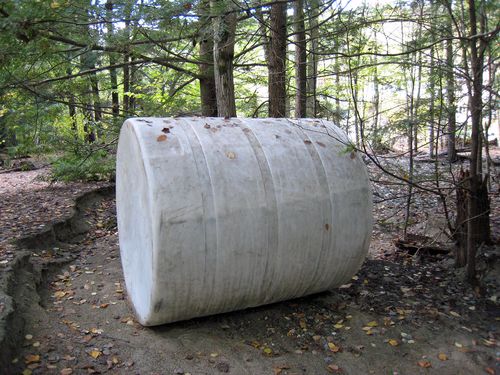
    Look what the cat dragged in!


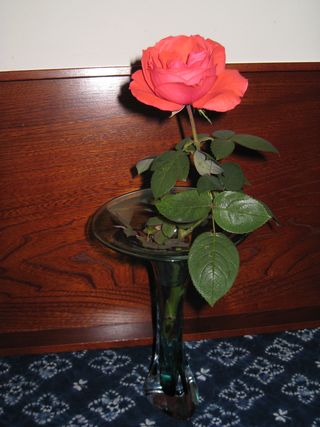
    Rose
    Jonathan Winfisky's glass (above) can be purchased

    at the Grow Gallery in Shelburne Falls. 


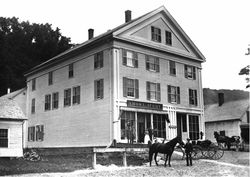
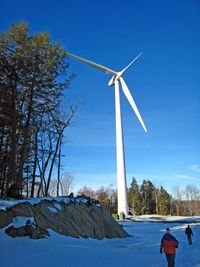
  • A year that started out so hopefully for us in Charlemont, a new windmill and an old store turned 150, turned out to contain multiple weather disasters for Western Massachusetts with Hurricane Irene causing the most distress in the hilltowns. 

    Avery's Winmill2


    Avery's store c. 1880


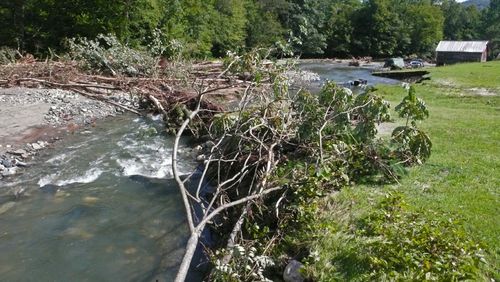
    Blockage of Mill Brook2a

    The Mill Brook off course during Hurricane Irene 

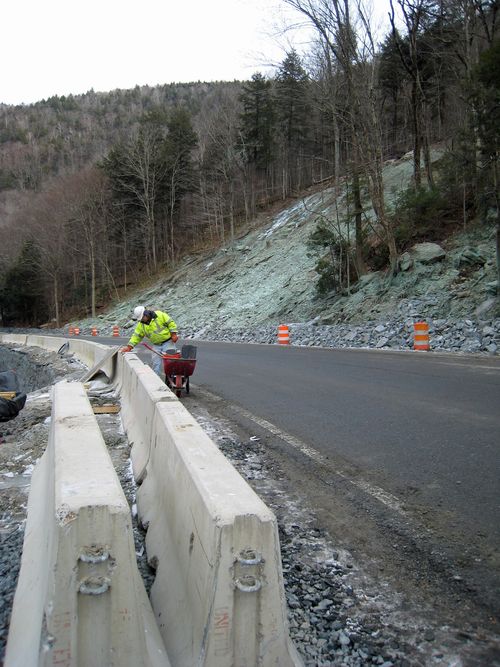
    As 2011 drew to a close, however, there was much to celebrate in the re-opening of Route 2 between Charlemont and North Adams.  Six miles of this major artery, closed since the hurricane on August 28, re-opened the week before Christmas.  Until we traveled the newly opened roadway, we had no idea of the magnitude of the damage: entire mountainsides had washed onto the road, which had toppled into the river in many places.  With crews working round the clock, what should have taken an entire year to complete was finished in less than four months, although men and machines are still at work to stabilize the landscape.

    Route2
    Route 2 in Savoy, December 30, 2011

    Route2coldriver
    Stabilizing the banks of the Cold River

    Thankful for this 23 million dollar Christmas present from our state and federal governments, we pray that continued "recovery" continues to bless us all in 2012.


    Happy New Year from Mill Brook House!!


  • Goat 

    Johnny, We Hardly Knew Ye

    With enormous regret we announce the departure of John Miller and Goat Rising from the farmstead at the corner of Route 8A North and Mountain Road.  Goat Rising, under new ownership, has moved to Plainfield while John and his Jerseys have joined the centuries-old Appleton Farms in Ipswich.

    John and his aunt purchased the farmstead in 2003, the year before we bought Mill Brook House. As John added Jersey cows to the goat farm, the herd increasing each year, the farm’s limited pastureland became an increasing liability. Goats The addition of the Curtis Country Store to the farm’s enterprises, delightful though it was, turned into another liability.  Recession, bad tenants, and a devastated real estate market combined to make for steep losses.  But the straw that broke the camel’s back seems to have been Hurricane Irene and the damaged bridge over the Mill Brook in front of the farm.  The months-long four-mile detour over dirt roads meant headaches for John and his family getting out and deterred customers for the farm’s store from coming in.  More losses. 

    Bridgeout


    Ironically, the week John moved, the bridge was finally repaired.


    The boutique farm with its prize-winning cheeses, raw milk, fresh eggs and delightful animals was the highlight of our neighborhood, a favored destination for a walk for ourselves and our guests, a wonderful of source not just of local produce, but of produce from animals we knew personally.  CowsJohn’s mother was a superb baker, and after the Country Store closed, her cookies and muffins appeared serendipitously next to the ice cream freezer in the farm store, providing a quick pick-me-up after a day of painting or laboring in the garden.


    True, it wasn’t all Irene’s fault, but the loss of Goat Rising after so many other losses from the hurricane is painful and deeply felt.

    Cat

    I attach my review of Brad Kessler's memoire of goat farming, which evokes our own fond memories of Goat Rising.

    Book Review: Goat Song

    This book was a natural choice, given the goat farm down the street from us.  Raising goats is clearly not for the dilettante or the faint-hearted, and we’ve seen evidence of that, too, in our immediate neighborhood.  One neighbor thought she would rescue a male kid, slated to be shipped off to more or less certain death by Goat Rising.  (Few males survive in the world of domesticated goats, where milk and cheese are the goal.)  Our friend stuck it out for several years, taking him for walks among the stones and boulders in the Mill Brook, but he finally became too much for her (though I believe she found another home for him, where he could continue being a pet).  Further up the road in Heath, we met a woman keen to raise goats as a hobby, but the young kids we saw on her property at the time have long since disappeared. 

                These failures become understandable when one reads of the sheer hard labor involved in raising goats in Brad Kessler’s Goat Song, which Kessler’s poetic style does not disguise.  The book makes a good companion and intriguing counterpoint to Barbara Kingsolver’s Animal, Vegetable, Miracle, about her year-long quest to live off her land or that of local farmers.  Where Kingsolver is polemical, Kessler is lyrical and philosophical (and far more economical with words).  Where Kingsolver gives us current information about government policies and the sad, wasteful state of our food supply, Kessler delves into our pastoral and etymological history—all the English words that derive from Indo-European, Greek, and Hebrew for goats and herding, along with slivers of poetry and wisdom on same, passed down from the earliest civilizations to the present.  Where Kingsolver may leave us feeling frustrated at the imperfect state of our of lives and our government—most of us don’t have the time, the land, or the money to eat as much local produce as we’d like—Kessler leaves us feeling ennobled by our rich pastoral heritage, even as we experience it vicariously through his labors            

         Surprisingly, this tiny, erudite volume involves a certain amount of suspense: when one of the goats sickened, I couldn’t stop reading until I learned the outcome.  Ditto when the herd was threatened by coyotes.  (The battle with the coyotes calls to mind Kingsolver’s Prodigal Summer, where two characters duel over the merits of conserving vs. killing these predators.) 

                Romantics will revel in the connections Kessler discovers between pastoralism and the notion of a lost paradise, as well as his discussions of shepherd-kings, poet-herders, and the haunting music of herding. Animal-lovers will understand better what they already intuit but society too often denies: that out of our deep connection to animals arises our humanness. Foodies will enjoy Kessler’s blow-by-blow description of cheese-making, although theologians and devout Christians may wince at the parallels he draws between cheese-making and Christianity, however much the two crossed paths in ancient monasteries.

                By the end we understand that this rich tale has been Kessler’s own spiritual journey, even as it has rubbed off on us and contributed  to our own enlightenment.  “A goat has led me here,” he writes in his penultimate paragraph.  “I’m the boy in the Yiddish tale who’s followed her all along—she always knew the way back home.”

    Goats 


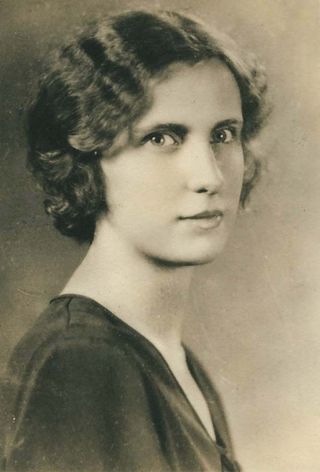
  • Veteran’s Day this year will be 11-11-11.  It won’t happen again for another millennium.  2011 is also my mother’s centennial, a year she didn't live to see, although she came close.

         Margaret4

    She died in 2004, the year we bought Milll Brook House, and money from selling the modest home in Michigan where she had lived since my birth helped us survive unemployment in 2006 and retain our our new old house.  I sometimes wonder what she would have thought of our purchase.  She would have worried that we could never manage such a big project on our small budget (as I often do myself), but she would have taken pleasure in the thought that we were embarking on a new adventure, living out a dream that she had had.  Although she did not live in a large city, she always hankered to move outside of town and live in the countryside.  Driving through woods and fields to a neighboring town, she liked to point out the house, about halfway between, that she had always wanted to buy.

    Yet her own life was not without adventure, some of her own making, some her husband’s and some the world’s.  As a high school graduate, she went off, without her mother’s blessing, to study art at Pratt Institute in New York City.  She was nine months pregnant when the Japanese bombed Pearl Harbor.  Baby in tow, she joined my father where he was stationed in Texas, and, like hundreds of other Army wives, criss-crossed the country by train with her toddler as the Army shifted my father around, eventually sending him overseas.

    In the late 1950’s, she followed him to Okinawa, where he, a civilian college professor by then, advised and taught English teachers at the University of the Ryukyus.  Interested above all in people and art, she took the island by storm, encouraging local artists and befriending a multitude of Okinawans and other island residents, instilling confidence and burnishing pride in a population traditionally held in low esteem by mainland Japanese and still reeling from war.  Those friendships lasted a lifetime, and among a certain, now-aging circle she is still a legend.

    Unselfconscious, she lacked the “shy-gene” that plagues the rest of our family and had, as my father liked to say, a gift for friendship.  There was hardly a place I could travel where she didn’t have friends for me to look up, and they always showered me with kindness in remembrance of her hospitality and affection toward them.

    She was part of the “Greatest Generation,” and she lived up to that moniker.        


  • Mill Brook2

            The beautiful Mill Brook

    Downgraded to a tropical storm, Hurricane Irene made its way relatively languidly through the northern Appalachians, dumping record amounts of rain and causing massive flooding.  Little Charlemont, which, in the past, had escaped floods, ice storms, and tornadoes, took a direct hit.  The beautiful Mill Brook, for which our place is named, decided to play Niagara Falls for a day and roared down the valley, ripping out trees along the banks, which smashed into bridges and destroyed them. 

    Bridge to goat farm
    The bridge by Goat Rising

    In DuPree’s horse pasture, the brook jumped its banks, tumbled across the field and roared around our house, wiping out the dog pen and turning our meadows into moonscapes.  For five stomach-churning days, it continued to race past us along the beds of two small streams that surround the back field, while its normal course lay empty. 

    Blockage of Mill Brook2a
    Trees and silt caused the brook to change course.

    On Thursday, Jerry and Brian DuPree tried, with backhoes and a small bulldozer, to force the brook back into place, only to watch it jump out again in the wake of another flash flood.

    At 5:00 Friday afternoon the cavalry finally arrived. 

    Cavalry
    Help at last

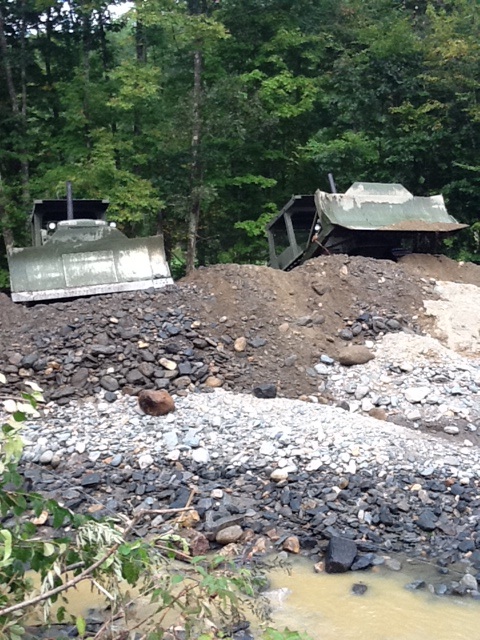
    National Guard troops with giant bulldozers moved earth and rocks and trees to get the Mill Brook back on course.  No Frenchman on D-Day was ever more elated to see American soldiers take to the field.  They worked through the Labor Day weekend, securing the brook, and on Monday, with more flash floods predicted, they showed up on our property to cut up trees already in the brook to prevent them hitting the Bissell Bridge, which, thankfully, received no injuries from the storm.

    TroopsMBH
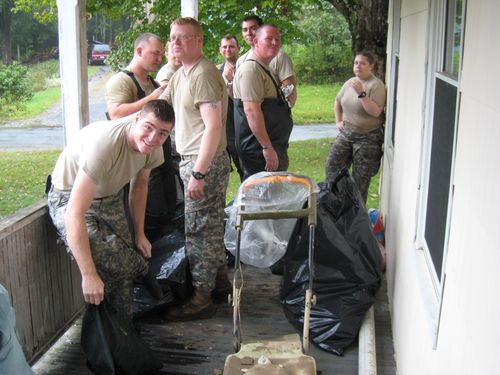
    Entertaining the troops at Mill Brook House       

    Badly in need of relandscaping, Mill Brook House is presently closed to guests.  We hope to open again next summer.  Goodnight, Irene.

    (Photos courtesy of Steven Sternbach and Jerry DuPree.)

  • Culling our video collection prior to the latest renovation project, I came across some old dubs of Northern Exposure which we’d made in the mid 90s.  (Both TVs at Mill Brook House have video playback, so most of our videotapes have migrated here.)  While I’d seen the shows broadcast, I’d never actually watched these tapes.  Throwing one into a video player, I quickly entered a time warp.  Intelligent people being kind to one another, enjoying quiet moments of self-realization and personal growth—when was the last time I had seen that acted out on television?

             What gave these old dubs even more resonance, however, was how much more I could identify with the residents of Cicely now that I know Charlemont; the need to accept people, whatever their politics, religion, sexual preference or profession because they’re all you’ve got, was suddenly very real.  I used to wonder about the eight principals on Northern Exposure—why only them?  Didn’t other people live in Cicely?  But, in fact, my circle in Charlemont is pretty much confined to the same ten or twelve people I encounter regularly as neighbors, tradesmen, shopkeepers, farmers—and not to forget the post mistress.  For me, Cicely, Alaska, has become a little less of a fantasy town than it used to be.

             Below are some of my four-footed and post-and-lintel neighbors.  Just out of sight are some really great people.

     Hallenbeck house

    The Hallenbeck House in Winter


    Bissell Bridge
    Bissell Bridge and Waterfall 


    Fawn
    Fawn in our Front Meadow


     Schoolhouse
    Former One-Room Schoolhouse


    GoatRising with Schoolhouse
    Schoolhouse seen from Goat Rising Farm


    Goat
    Goat Rising Goat


    Cow
    Goat Rising Cow


    Horses
    Next Door Neighbors