•  

    Book.image
    In 2017 I decided to write a book about the Japanese filmmaker Yasujiro Ozu, and I spent the next three years closely analyzing his 33 extant films along with 3 fragments, researching the historical background, and catching up with what other scholars had written.  I had been writing about Ozu since 1983, and my most recent article was published in 2010.  That article went into the book almost unchanged, but, in fact, every article I had ever written about him went in in some form, sometimes as only a paragraph or a single sentence, along with material from my earlier book on Wim Wenders and some of my research on Hollywood’s 1950s films about Japan.  But much of my analysis was new, and most of the older material was rethought, revised, and updated.  I critiqued previous authors, whose work other scholars had let stand, when I thought parts of it did not hold up under close scrutiny.  I nevertheless benefitted greatly from the research and insights of many of those same authors as well as material from many others.  Among those I leaned on most were David Bordwell, Peter B. High, Kyoko Hirano, Tadao Sato, Mitsuyo Wada-Marciano, and historians John Dower and Ben-Ami Shillony.  Anthologies on Asian film in general and Ozu in particular also proved a wonderful resource, particularly one edited by Jinhee Choi and those by edited by David Desser (with or without colleagues).

     I finished the first draft just as the pandemic struck and was able to spend the next six months revising without interruption, thanks to the pandemic lockdown.  Securing a publisher took another six months, but, finally, in April of 2021, Hong Kong University Press snapped up the manuscript proposal, toward which American presses had been fairly indifferent.  I spent the entire next year revising, editing, gathering illustrations, and creating an index. Finally, in June of 2022, Ozu: A Closer Look rolled off the presses and arrived at my house.  I approached the package apprehensively, like a new mom hoping her child had all its fingers and toes, but I needn’t have worried.  HKUP did a beautiful job and continues to be a delight to work with.

    The book is divided into three parts.  The first takes up issues concerning Ozu’s silent films, including a close analysis of his three “gangster” films, the symbolism he used in his silent period, how he pictured sound in these films, and how he structured narrative.  In Part II I looked at his first ten sound films, which were made as Japan’s war with China intensified then morphed into a war with the United States, followed by the American Occupation of Japan, which lasted until 1952.  Each of these films finds Ozu endorsing the policies of whichever government was in a position to censor them while at the same time offering subtle critiques and sometimes mocking those same governments.

     Part III takes up specific themes that pertain to all of the films but particularly those later, mainly color films from the 1950s and early 60s that closed out Ozu’s career.  These themes include narrative strategies and meaning in his late films, his take on gender issues and religion, the extent to which other two-dimensional art forms in Japan (i.e. painting and printmaking) influenced or coincided formally, thematically, and ideologically with his work, and, finally, a discussion of a selection of specific films and filmmakers whose work was influenced by Ozu. 

    This book concludes my decades of work on Ozu, whose films will never get old.  I hope it will prove a valuable companion for those wanting deeper insight into the filmmaker and his films and that it, too, will stand the test of time.


  • The first of at least four films paying tribute to old movie theaters, The Last Picture Show (Peter Bogdanovich, 1971) involves a relationship between a middle-aged woman (Cloris Leachman) and a teenaged boy (Timothy Bottoms).  Sam Mendes has updated the story to a tourist town on England’s South Coast in the 1980s.  Stephen (Michael Ward), who is Black, is trying to get into college when he takes a job at the local movie palace, whose upper floors are shuttered.  He begins an affair with co-worker Hillary (Olivia Colman), a mentally fragile, middle-aged woman, whose love-life consists of having sex with their married boss (Colin Firth) in his office.  Stephen frees Hillary from that bad relationship, but his own with her has no future, either.  Shattered when Stephen breaks off their sexual liaison, Hillary must find her way to a more appropriate friendship with the ever-loyal Stephen, who is forced to face down discrimination and violence on his way to being accepted into college.

    The film moves slowly, punctuated by two loud and jarring episodes: Hillary’s breakdown upon Stephen’s withdrawal from their affair and the attack on Stephen, in the theater, by a group of skinheads; both involve the violent smashing in of doors.  Parallels, in fact, structure the film: Hillary’s two affairs; the “family” of theater workers, frequently shown sitting around the table in their break room, and Stephen’s small family, also shown sitting at their kitchen table; Hillary’s dead but formerly philandering father and her boss; Stephen’s absent father and the projectionist’s confession that he, too, had run out on his wife and son.  These parallels anchor the story and, along with its evocation of goodwill and tolerance, keep it from floating away on the tides of Hillary’s mercurial personality even as its strength comes from the uncompromising depiction of her instability

  • Ozu- A Closer Look by Kathe Geist

    If you haven't read the book but you'd like to see the movie, here is the link: https://youtu.be/lISq-7bID94


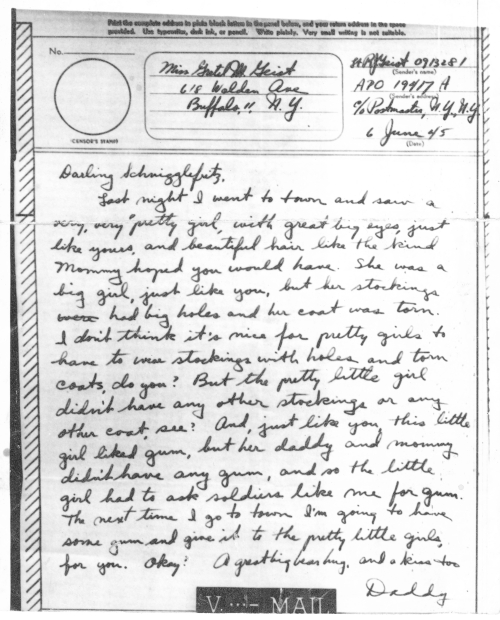
  • World War II left millions of children wounded, homeless, hungry, impoverished and often orphaned in defeated and victorious countries alike, as the V-mail below attests.  In the United States, the kids were, for the most part, all right, although the stress and dislocation of the war years left some homeless, as a youthful Maya Angelou discovers in I Know Why the Caged Bird Sings.  But impoverished or not, universally, across the globe, children waited for their fathers to come home.

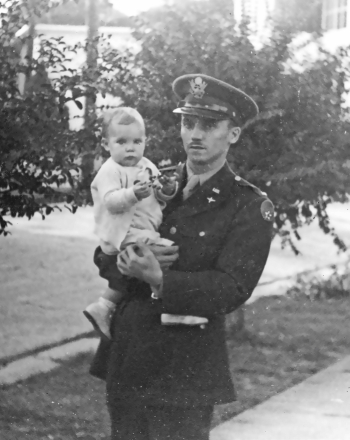
    My sister Gretel was born within a fortnight of the bombing of Pearl Harbor, and for most of her first four years my father was a soldier. 

    G&D Gretel and Dad.1

    He was discharged from the Army in the fall of 1945 after spending five months in London interrogating German POWs . He reunited with his tiny family at my grandmother’s house in Buffalo since the Army did not house dependents once soldiers were deployed overseas (which may explain why some kids ended up homeless).  Removing his officer’s hat, he threw it on the floor, emphatically declaring, “I’m done with the Army!”–at which point my sister burst into tears!  In her mind his Army uniform was as much a part of him as his mustache.

    V-Mail '45.1
    V-Mail from London, June, 1945, from my father to my sister, describing a little girl in ragged clothing, hoping for some chewing gum from American soldiers


    Kids on VE Day.3

    Children’s parade on V.E. Day (May 8, 1945) in San Antonio, TX.  Gretel is pushing a baby carriage; the boy behind her rides a tricycle, and the child behind him carries a watering can; the boy in front carries the flag.


  • Io Capitanopix

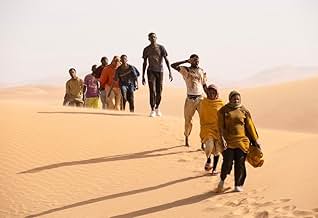
    In a year of good films, Io Capitano [I Captain] stands out as both incredibly moving and well-crafted.  It is the story of two teenaged cousins who leave their home in Senegal, hoping for a better life in Europe.  Their dreams are big, but their ignorance and naiveté are way bigger.  Italy is their intended destination, but first they must get to Tripoli in Northern Africa.  They encounter unspeakable horrors on the way, and we, the audience, keep wondering if they will succeed in their ambitions or be crushed.  What judgment will the film render on their decision to leave against their mothers’ protestations and the advice of far wiser minds?  But this is not where this brilliant script and amazing acting takes us.  Conned into piloting a rickety boat filled to over capacity with other refugees, the boy Seydou shouts at the helicopter hoving over their craft off the coast of Sicily “I’m the captain!  I saved everyone!  No one died!”

                No one died.  This is the outstanding achievement.  Seydou has retained his humanity in the face of unbearable inhumanity.  Thinking back we should have seen this coming: Seydou turning back to help a woman dying in the desert, his refusal to leave Tripoli without his cousin Moussa.  And he in turn benefits from the kindness of others.  An older man, a skilled laborer, temporarily “adopts” him, saving his life; a refugee physician treats Moussa’s wounded leg and helps Seydou to procure black market drugs for his cousin.

                Our expectation that the film produce a resolution regarding the boys’ ambitions are, of course, justified.  This is a journey film, a road movie, a buddy film, a quest narrative, a literary form as old as Western literature itself.  And part of the boys’ dream is realized: they reach Europe.  But whether they will find a better life, whether the harrowing journey was worth it, these questions are never answered, and we are left instead with the understanding that how one journeys is as important as the goal: “I saved everyone; no one died!”


  • *Fam Portrait2Kathe and Steve at home with Rocky, Pepper and over a dozen home-grown pumpkins!

    Mill Brook House, vacation spot and part-time rental, is now our permanent home!  Nellie Fox, the fierce shiba inu, is no longer with us and neither is lovable Sandy, champion mouser, whom we acquired soon after Nellie’s passing.  Rocky, once half of the Sandy-Rocky show, continues to enjoy the great outdoors as does Pepper, our mini-Australian sheepdog.  In 2016, they were joined by baby Max, another yellow tabby.  (Sadly, Max left us prematurely, and we adopted baby Taz in 2023.) Taz

    Max7_edited-1

    Mill Brook House, first renovated (2004-2006) to accommodate vacationers, has, more recently, undergone renovations to make our permanent residence possible.  We have extended the loft over our attached, two-part garage, built a staircase to the attic and a large new closet on what was once a spacious landing, completed a new guest room with its own closet (a rare commodity in this house), constructed a massive bookcase in the living room where we once tucked a trundle bed, further improved the downstairs bathroom, ditched the 1920's kitchen sink, and turned the downstairs bedroom into a glorified pantry.  To the swimming-pool-turned-garden from 2004, we added a second garden when Hurricane Irene made re-landscaping necessary, and in 2015 we built a third garden dedicated to gladioli and vegetables.  We have also launched a daylily business (see millbrookhousedaylilies.com). 

    Millbrookhousenews.com will continue to offer insights and information on Western Massachusetts, occasional film and relevant book reviews, our photographs of the area, including wildlife, landscapes, and landmarks, and personal essays.  Recipes have been spun off onto their own blog, millbrookhouserecipes.com.  For more of Steve's photographs, see sternbachphoto.com. We hope that you will enjoy all four blogs!  You can comment right on the blogs or email us at foxacres12@gmail.com.  

    New House Photo1 Blog
    Mill Brook House, summer 2013


  • In John Ford’s enormously seminal film The Searchers (1956), two men spend five years searching for a young girl who has been abducted by Indians. When they find her, she has entered her teens and become one of the chief’s wives. At first she declares her allegiance to the tribe but later changes her mind and agrees to return home with the men. The reasons for her change of heart are never explained, nor did they need to be for a 1950’s audience. The girl had obviously come to her senses, remembered her past, and realized the advantages of returning to “civilization.” Such was not the case, however, with most white women captured as children and raised up in Indian tribes. Spinning

    One of the best documented cases is that of Eunice Williams, daughter of a prominent Puritan clergyman, who, with her father and brother, was captured in the 1704 raid on Deerfield, Massachusetts, by Mohawk Indians and their French allies and marched 300 miles to Montreal through deep snow. The raid was a small piece of the War of the Spanish Succession—the one that made Winston Churchill’s ancestor Lord Marlborough famous—which had spilled over onto the American continent. The raid took place before dawn on February 29 and is commemorated every leap year by the Pocumtuck Valley Memorial Association. (Pocumtuck is the name both natives and colonists used for Deerfield at one time.)

    This year’s commemorative events included lectures, reenactments, and demonstrations of colonial housekeeping crafts.

    Cooking

     Re-enactors, many of whom had come considerable distance, staged the battle that took place after the attack on Deerfield when militiamen from Northampton and other nearby settlements, seeing flames, marched to Deerfield and engaged the French and Indians as the last of them were leaving the burning village. Turned back by an ambush, the militiamen were unable to rescue any of the captives. This year about twenty re-enactors, pretending to be Frenchmen, English colonials, Mohawk and Abenaki, stood in for what had been a battle involving about 300 men. This left much to the imagination, but a narrator helpfully told the story while the actors “did battle” on a field at the Deerfield Academy.

    Militia_edited-1

    As for Eunice Williams, although her father and brother were eventually “redeemed” (ransomed) and returned to Deerfield, she never went home. Captured specifically to take the place of a Mohawk child who had died, and converted to Catholicism by her Indian family, who lived in close proximity to the French, she refused every attempt by her father and brother to persuade her to return. As a teenager, she fell in love with a fellow tribesman, and, although dubious about the inter-racial union, the local padre married them when they declared they would live together unwed if he did not. Throughout his life, her brother, a clergyman like his father and tortured by fears for her immortal soul, wrote to and of her, and, on occasion, she and her husband visited him, pitching their tent in his yard in preference to sleeping in the house. Eunice herself remained illiterate, so we have no record of what she actually thought about her life with the Mohawk, although her actions speak quite loudly.

    For more on Eunice Williams and the conundrum she posed for her family, see John Demos, The Unredeemed Captive (1994). To observe the next commemoration of the 1704 raid on Deerfield, you’ll have to wait until 2020.

  • Gould's.table

    Gould's, the iconic sugarshack restaurant on Route 2 in Shelburne, has closed.  Gould's has served tourists and locals alike since 1960 and will be sorely missed.  

    Davenport1                                       Davenport Maple Farm Sugar Restaurant

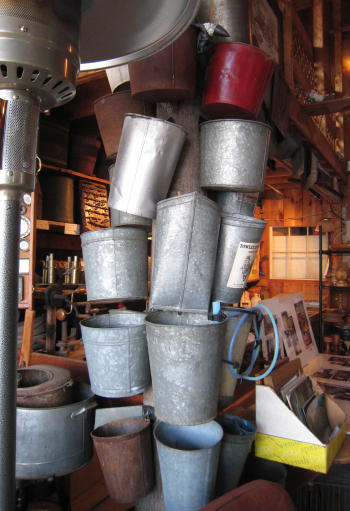
    But off Route 2 at 111 Tower Rd. in Shelburne is Davenport Maple Farm with a restaurant, sales area and evaporator to view.  The restaurant is opens in the sugar season March to mid-April, 8:00-3:00. Their pancakes and other syrup delivery items are quite straightforward and include gluten-free options, but their "Finnish" pancakes are unusual and delicious! Diners are served a 2 oz. bottle of maple syrup to use with their breakfast and take home as a souvenir. Davenportpails                                      Sap buckets hang near Davenport's evaporator.

    Red BucketsThe Red Bucket Sugar Shack's red buckets         

    Sadly, this delightful sugar shack has closed its doors for good, but I leave the pictures up in memory of it.  Worthington in western Massachusetts is far off the beaten trail from Charlemont, but when the Red Bucket Sugar Shack topped a 2013 Fox News survey of the ten best sugar shack restaurants in the U.S., we had to go.  RBevaporator

    We were happy to report that Fox News has much better taste in restaurants than in politics!   


    Red Bucket sales
    The sales area fills with steam from the evaporator (above).

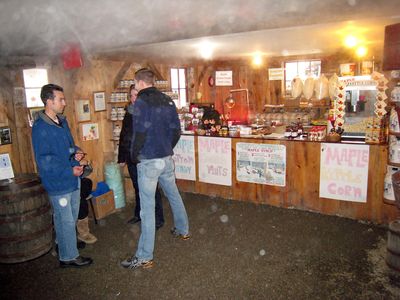
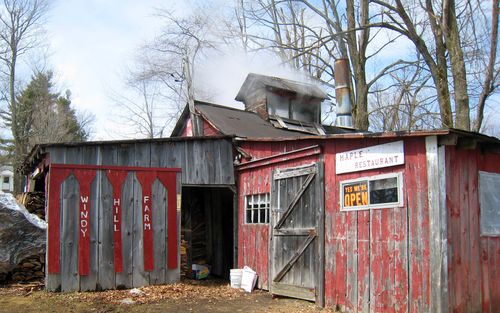
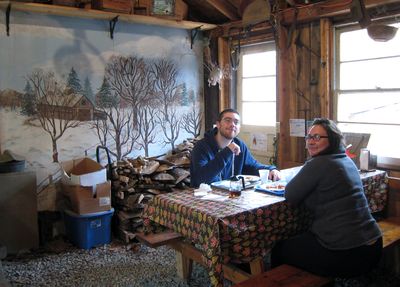
    Worthington boasts two other sugar restaurants, both open weekends in the foliage season as well as the sugar season. Just off 112, Windy Hill Farm claims to be the oldest sugar shack restaurant in Massachusetts and is certainly the most rustic.  If you need cream for your coffee, an open pint will appear on the table, family members grab breakfast among the guests, and if you need to use the facilities, a genuine outhouse awaits you. 

    WindyHillext
    Windy Hill Farm: the oldest sugarshack restaurant in Massachusetts

    But the food is plentiful and good: feather-light French toast, waffles, or a variety gigantic pancakes—apple, pumpkin, chocolate chip, blueberry—that you can mix and match, and the restaurant has a loyal following and a longer season than most.  It’s open from 8-2 in a sugar season that lasts from late February until Easter and re-opens in foliage season.

    WindyHillint
    Inside Windy Hill

    South of Windy Hill, right on 112, the High Hopes Farm sugar restaurant, open from 7-2,  serves an all-you-can-eat buffet… 

    HiHopes1


    Satisfied customers at High Hopes Farm


    …with pancakes, French toast, scrambled eggs, home fries, bacon, sausage, ham, and a variety of beverages including tea, juice, and coffee.  A pitcher of pure maple syrup sits on every table, and, if you sit near the window, you'll look down on a beautiful gorge, carved out by the Little River.

    HiHopesldsp


    The Little River runs behind High Hopes sugar restaurant.


     In the fall, High Hopes turns its evaporator room into a haunted house and serves the same plentiful buffet.

     A number of sugarshack restaurants serve the I-91/Northampton area. Steve’s Sugar Shack at 35 North Road in Westhampton is open weekends from late February through mid-April from 7-1. The menu is limited, but the French toast is delicious and the blueberry pancakes look great. Steve’s employs an efficient system for ordering your meal. Guests are seated at long tables near or below the evaporator. On Sundays, a neighbor brings his oxen, who, ostensibly, pull a sled outfitted with a tank to gather sap from buckets in the woods. (When we were there, however, the oxen mainly greeted visitors, while their owner explained how he used them for his logging business as an environmentally friendly alternative to a truck.)   OxenSteve'sSS


    Oxen greet visitors and (maybe) help with sugaring at Steve's Sugar Shack in Westhampton. 


    Williams Farm Sugarhouse, located on Routes 5 & 10 just south of Historic Deerfield, is open daily mid-February to mid-April and serves a variety of delicious pancakes, waffles, French toast and various sides, including maple cream doughnuts.

    Stirring boilThe Williams family began sugaring on Mt. Toby in Sunderland in the 1850’s and opened their more conveniently located sugarhouse in Deerfield in 1994. Patrons order at the counter and can visit the evaporator in the next room while they wait for their food. 


    A Williams family member stirs the boiling sap.  A sign from the original Mt. Toby Sugarhouse sits against the wall.


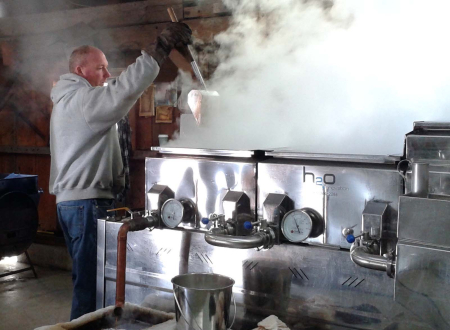
     The North Hadley Sugar Shack is conveniently located on Route 47 three miles north of Route 9 for those who want to visit the Amherst area. 

    NHadleySS They serve the standard French toast, waffles, and pancakes, with eggs if you want them and ice cream, fruit and whipped cream toppings also an option.  Breakfast is served every day in sugar season (mid-February to mid-April) from 7:00-2:00.  Compared to the more out-of-the-way sugar restaurants, service here is very fast.  Visitors can view the evaporator, which sits right outside the dining room, and a well-stocked farm store is open for most of the year.  HadleySS


           Tending the evaporator at the North Hadley Sugar Shack


    StrawbaleCafe

    The Strawbale Cafe at Hanging Mountain Farm at 188 North St. in Westhampton is open year round for breakfast every Saturday and Sunday from 9-2 except in January.  The cafe has a full breakfast menu, including pancakes with a wide variety of add-ins, during most of the year but is more limited in sugar season because of the large crowds.  The menu is simplified at that time and pancakes are limited to chocolate chip and blueberry, but, of course, the sugar house is working and can be visited.  Seasonal vegetables, like asparagus, are added to the menu as they become available.  The cafe is so named because it is made from bales of straw although these are covered by wood and stucco, so you won't see any straw when you visit. SBCsugarhouse 


    In the town of Hancock, almost on the New York border, Ioka Valley Farm offers four-season family entertainment, not least of which is its maple breakfasts, served from mid-February to early April on weekends 8-3.

    Ioka Farm.ext

    Once a dairy farm, Ioka offers an array of pancakes and French toast, including a delicious stuffed French toast, in the former calf barn, aptly named the Calf-A.


    Ioka Farm Int

    Visitors can observe an enormous high tech evaporator and purchase all grades of maple syrup as well as maple cream, maple sugar, maple cotton candy, cider doughnuts and other farm produce. Ioka’s four-season entertainment includes a petting zoo and play with wooden bovines in the summer and fall.

    Ioka.Lamas
    Ioka.Cows2a

  • Max with Sharpener1-2

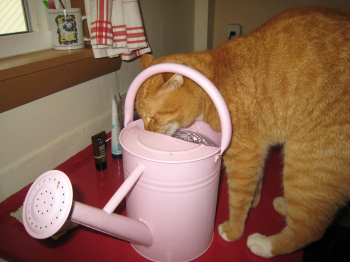
    Max was like a delicate flower that faded too soon.  He had a water fetish and loved to drink from a running tap, from an unguarded cup or glass or even a watering can; he tracked kitty litter into the bathtub as he examined the droplets that gathered around the drain.  A mischief-maker, he chewed on paper documents and tipped over waste baskets to get attention.

    Max7_edited-1

    Max drinking

    He had a purr like the running engine of a Mac truck and engaged it incessantly, signaling hunger, affection, or pure joy.  He slept on our bed by my feet or cuddled up with companion Rocky for an afternoon snooze. Sleeping together Neither as athletic nor brave as Rocky, he was nevertheless unafraid of Pepper, our well-meaning but over-active mini-Aussie, whom Rocky loathes.  Max was the peace-maker and go-between.

    Max & Pepper

    Cat detective1
    Christmas 2021

    Maxwashing


    Sweet, petite, and beautiful, he stole our hearts and has not returned them.

    Maxintunnel"Good night, sweet prince; And flights of angels sing thee to thy rest."


  • Mom10b

    Gertrude Erlich was born in Rotterdam, New York, not long after her father, Sam Erlich, had immigrated from Poland, possibly at the behest of his sister Betsy and her husband Jake Coplon.  The Coplons settled in Schenectady in upstate New York, where they opened a successful children’s clothing store.  Sam, who immigrated with his second wife and three children from his first marriage, opened his own store in Rotterdam and fathered five more children, including Gertrude, but found the community unsatisfactory, due to either anti-Semitism or a lack of Jewish neighbors or both and relocated the family to Brooklyn.

    Mom & Her Dad'27a

    Gertrude and Sam, 1927

    He died soon after, and his widow relocated again, this time to the Jewish enclave in Manhattan’s lower East Side.  A teenager by now, Gertrude joined the Hebrew Educational Society (H.E.S. or the Edgies) where she began keeping company with Abe Sternbach, six years her senior.

    His mother’s sole support and suffering from poor eyesight, Abe, a commercial artist, managed to stay out of World War II until 1944, when he was drafted and shipped to the Philippines to paint signs for the Army.  Gertrude met him upon his discharge in North Carolina and suggested it was high time they got married.  They settled in a basement apartment in the Bronx, and, in 1949, Steven, their only child, was born.

    Like many couples after World War II and with the help of government-subsidized housing, the Sternbachs merged into the middle class.  They moved to Brooklyn; Abe continued working as a commercial artist, while Gertrude raised Steven and eventually worked part-time for the Brooklyn Public Library.

    Mom and Steve '54.1Gertrude and Steve, Greenwich Village Art Fair, 1954

    She never lost touch with her Coplon relatives, and, once they acquired a car, the family made frequent trips to Schenectady.  Abe retired early, and the couple rediscovered the Edgies, joining a Brookline branch of H.E.S.

    For Jews everywhere, but especially for those whose families had immigrated to America in the last decade before the U.S. slammed its borders shut in 1924, the grim news of the Holocaust evoked the specter of “there but for the grace of God, go I.”  For that generation, the founding of Israel came as a great triumph and a great relief.  In the late 1970s, Gertrude fulfilled a decades-old dream of visiting the Jewish state.

    Mom@1940 WF1aGertrude at the New York World's Fair, 1940