• Depression Glass_edited-1                                                Green Depression Glass (photograph: Steven Sternbach)

    I first encountered the fashion for “vintage Pyrex” a decade ago when I discovered that the mother of a Japanese student I was tutoring shopped for it regularly in antique and second hand stores, intending to ship it back to Japan where it sold for a bundle.  Recently I came across an article citing pieces that sell for hundreds even thousands of dollars in this country.  I gag.  This pale milky glass kitchenware with insipid floral designs is the stuff your mother gave you when you got your first apartment.  It goes with olive stoves and yellow refrigerators.  Who wants to remember that unfortunate period of kitchen design?  A lot of people, apparently.

    I am reminded of the first time I came across Depression glass in my late teens.  I was fascinated by the colors.  My mother sniffed, “Oh, Depression glass.”  People couldn’t afford quality glass in the 1930s, so manufacturers colored the glass to cover up its imperfections.  My mom didn’t find the Depression and its necessities any more nostalgic than I find the tastes of the 1970s.  Unlike Pyrex, you can’t apply heat to Depression glass, but I still treasure the large emerald green salt and pepper shakers, the pale green reamer and the four-cup measuring cup that I have acquired over the years from flea markets and antique stores, and I use all of them, careful never to put hot water in the measuring cup.  Nostalgia is clearly in the eyes of the nostalgic. 


  • Trump tried to wreck the Post Office.  An army of postal workers called it out and made sure every mail-in ballot was delivered.  Trump trash-talked the election.  Over one hundred and fifty million people voted anyway.  Trump tried to stop the vote count.  Thousands of poll workers counted and counted and counted.  Lies went to court, and judges sent them packing.  Officials in multiple states suffered harassment and death threats.  They stuck to the truth.  A mob attacked and ransacked the Capitol.  Our senators and representatives crawled out from underneath desks and tables and certified the election by 4 AM the next morning.  When Lady Gaga sang the national anthem at Joe Biden's inauguration, it occurred to me that it had been written in 1814, the last time the Capitol had been attacked.  Now as then “our flag was still there.”  What can we say to those who stood up to sabotage, propaganda, lies, and attacks, verbal and physical?  That thanks to them, we are truly what we've so often claimed to be: “the land of the free and the home of the brave.”


  • Bunny

    In his children’s book, A Home Run for Bunny, Western Mass author Robert Andersen tells the story of local heroes Ernest “Bunny” Taliaferro and Tony King, high school athletes from Springfield, MA. Taliaferro, an immensely gifted African-American athlete, and King, captain of their American Legion summer baseball team, were set to compete in a regional championship. The year was 1934, the region was the entire Atlantic seaboard, and the playoffs were held in Gastonia, North Carolina. A Gastonia band greeting the boys, none of whom had otherwise travelled further than Vermont, stopped dead when Bunny emerged from the train, and a confrontation with Southern apartheid began. Bunny, so nicknamed because of his jackrabbit running speeds, was forced to register as his coach’s valet and sleep on a cot rather than a bed in the team’s North Carolina hotel. His demonstrated prowess on the field during practice further enraged the local community, and the boys endured not only cat calls and an avalanche of projectiles but threats of violence, purportedly from the Ku Klux Klan. When teams from Florida and Maryland refused to play with Bunny on the field and it became clear that the local police would be unlikely to protect the Massachusetts boys from an angry mob if Bunny played, the youngsters were forced to choose between a championship they could likely win, even without Bunny, and loyalty to their teammate.  Captain Tony voted to abandon the playoffs, and his team members agreed without a single dissent.

    For the locals, it wasn’t enough that the Massachusetts team had withdrawn. Refusing to honor their segregationist rules made the team a target, so the boys left town in the middle of the night, ferried to an abandoned railroad station in cars driven by sympathizers who left quickly, fearing for their own safety. A train headed north made an unscheduled stop and eventually deposited the young athletes in Springfield, where news of the incident had preceded their arrival. A huge cheering crowd greeted them with more fanfare and celebration than would have followed an actual victory.  Many years later one team member remarked on the quirks of history: “If we had gone ahead without Bunny, even if we had won the championship, no one would ever have heard of us.” Protesting the national organization’s indifference to racism, Springfield’s American Legion Post 21 disbanded its team in 1935. It was not revived until 2010.

    Andersen’s picture book, illustrated by Gerald Purnell, received many plaudits when it was published in 2013 for reviving the story of Tony and Bunny, though I wonder if the subject matter isn’t too sophisticated for the Winnie-the-Pooh set, who know little of valets, the intricacies of regional sports competitions, or Jim Crow laws (as distinct from slavery or the bullying little ones are likely to be warned about today). A novella for older children, replete with more detail and fuller explanations as well as the imagined thoughts and feelings of the characters, the sights and sounds of each location, the thrill of train travel, the joy of playing sports and so on would be a more appropriate vehicle. Andersen is reportedly working on such a project, and I hope it finds a willing publisher.

    Although Andersen makes Bunny the focus of his book, the story is not told from his point of view, and, given the current topicality of "white privilege," we should note that Tony King is the actual hero of the tale.  He is, in Biblical parlance, "a righteous man."  Tony and his white teammates have choices; Bunny has none, and his experience in Gastonia would shape his life.  Both Tony and Bunny remained in Western Massachusetts, but Tony just celebrated his 102nd birthday; Bunny would die at 50. Like many Holocaust victims and World War II vets, he never once told his children about his humiliating and terrifying encounter with race hatred and segregation in North Carolina. Referring to a newspaper picture her mother had kept of the crowd greeting the returning players, Bunny’s daughter Linda Taliaferro said, “Our grandparents were in that picture, and they had such anxious looks on their faces. I asked my mother why that was. ‘They didn’t know if their son would be coming home dead or alive,’” was the answer.  

    Throughout his life Bunny continued to exhibit extraordinary skill in sports and played on some Triple A teams after high school, but he turned down college scholarships, including one to Dartmouth, married a local girl, raised six children and worked at the Springfield Armory and then a tire company.  As an African-American athlete he faced dubious alternatives in the late 1930’s. He could have accepted recruitment to a college team from which he would inevitably have been cut anytime the team ventured south of the Mason-Dixon line.  (Ivy League teams notoriously sidestepped the scruples of 15-year-old Tony King.)  He could have joined the poorly paid, roustabout, and ultimately frustrating world of the Negro Leagues or served in a segregated Armed Forces.  Jackie Robinson, two years Bunny's junior, would do all of these things and, in 1947, break the color barrier in major league baseball, but this was hardly a foregone conclusion.

    The 1930’s were a progressive period fraught with inconsistencies in which Jesse Owens, fresh from his triumphs in the 1936 Berlin Olympics, was feted with a ticker tape parade down Broadway and, that same night, refused a hotel room in New York City; a time when Hattie McDaniel, awarded an Oscar (the first and last black actress so honored until Whoopi Goldberg in 1990) for her role as Mammy in Gone with the Wind, was compelled to sit at a segregated table in the back of the auditorium during the ceremony.  Even the lives of celebrated African-Americans, living outside the South, were rife with racist booby traps.

    That Bunny chose to stay in Springfield, where he was known, loved, and celebrated, is understandable, but clearly the suppression of so much talent took a toll. He died in 1967, the same year Thurgood Marshall was elevated to the Supreme Court and a few years after major Civil Rights legislation was passed by Congress—all too late for the Springfield athlete. Tony King and other former team members carried his casket; the summer of '34 had forged lifelong bonds.  King would live to see Barak Obama serve two terms as President and his 1934 team remembered and honored in the first decades of the 21st Century.  But it is probably Langston Hughes who, in 1951, evoked the ethos of Bunny’s story most poignantly:

    What happens to a dream deferred?

    Does it dry up

    like a raisin in the sun?

    Or fester like a sore—

    And then run?

    Does it stink like rotten meat?

    Or crust and sugar over—

    like a syrupy sweet?

    Maybe it just sags

    like a heavy load.

    Or does it explode?

    Jackie Robinson did not outlive Bunny Taliaferro by many years.  Robinson lived his dream while Taliaferro shelved his, but both suffered under the burden of the era's unspeakable racism, and neither saw a ripe old age.

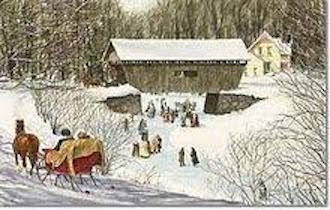
  • The moon still showed above the house across the street.  A light snow had fallen on Christmas Eve, and heading toward the covered bridge was pure Currier & Ives.  Large gray clouds tinged with pink moved slowly across the sky.  Up at the fairgrounds the sun rose over the eastern mountains, streaking the clouds in front with coral and gold.  Silhouettes of bare trees stood before them, creating broad stripes of luminous color that alternated with black.  A fox had been foraging before dawn and dropped a piece of her Christmas dinner for Pepper to find and carry home.  By now, patches of sky between the clouds had turned an intense, brilliant blue.

    C&I

  • Swallowtail.larvae
     Be kind to these guys (above) because they turn into these guys… DL-16.butterfly


    Swallowtail larvae love parsley and, if you grow parsley, will eat it to the ground.  Solution: plant a special parsley bed away from the one you use for your kitchen and gently place any swallowtail larvae you find in the wrong patch onto the parsley in their designated patch.  (They also love dill…)  Currently there are five swallowtail caterpillars in this particular patch.  Two are visible in the photo.  They are as beautiful as the butterflies they turn into, but a lot more destructive!  Be a good neighbor and plant extra parsley for them.  You will be rewarded with floating, fluttering, black and yellow striped beauty throughout your summer.

  •  We spent our first Halloween at Mill Brook several years ago, and to mark the occasion, we purchased three pumpkins, one large and two small, and placed them by the front porch.  It poured rain, so no tricker-or-treaters came; they weren’t used to having us there for that holiday anyway, but the pumpkins remained until Thanksgiving, after which we carried them out to the septic mound for the benefit of any animals partial to pumpkin.  Before we left for home, I dug out the Christmas wreath Kathy Hallenbeck made for us last year and hung it on the front door.

                On the drive home, I pondered the firm divide we Americans create between Christmas and Thanksgiving, between our fall holidays and our winter ones.  Only on the day after Thanksgiving does Christmas shopping officially begin, and we castigate merchants as crass and thoughtless who jump the gun by putting out Christmas decorations before we’ve finished roasting our turkeys and devouring pumpkin pies.  Franklin Roosevelt tried to move Thanksgiving forward one week in order to boost the economy by allowing more days for Christmas shopping, testimony to our distaste for doing anything Christmas before Thanksgiving.

                Why this rigidity?  In Europe, autumn flows naturally into winter.  In October, fresh game with cranberry sauce is featured on menus, butchers hang dressed rabbits and pheasants outside their shops, and slowly fruit breads and Christmas stollen appear in bakery windows.  (“Backbeginn November” is the chapter in my German cookbook that covers these holiday breads.)  The aroma of sugar-coated nuts and roasting chestnuts fills town squares; outdoor markets sell springerle forms, cookie cutters, and crèche figures.  Giant lighted stars, strung above the main shopping streets, announce Advent: the bakeries now feature Christmas cookies, and churches fill up with candle-laden fir trees or other seasonal decorations.  The transition has been seamless.

                We Americans explain the line we draw between Thanksgiving and Christmas on the grounds that we have Thanksgiving and Europeans do not, but I think the real answer lies in the fact that our American fall traditions are all uniquely American: the squash and pumpkins, the turkeys, the brilliant autumn leaves, the scarecrows and cornstalks, the history of the Pilgrims, and the big deal we make out of Halloween—all American.  Our Christmas customs, on the other hand—decorated trees, holly, yule logs, mistletoe, carols, glass ornaments, roasted birds or roast beef and Yorkshire pudding, fruitcake and other confections—all derive, in one way or another, from Europe.  Even Santa Claus, uniquely American, especially when advertising Coke (!) started out as Saint Nicholas.  We don’t shift seasons as much as we shift cultures and continents, and the traditionalists among us don’t do it lightly.

    Nellundertree


  • Holland Dell

    Steven Sternbach, Holland Dell, Heath, MA* 

    One of our most memorable Thanksgiving dinners took place over a decade ago in New York’s Essex Hotel on Central Park South, where we were guests of our Manhattan relatives.  But through the decades “Over the River and Through the Woods” has conditioned most of us to think of a country Thanksgiving as the ideal.  That song, with words by abolitionist Lydia Maria Child, references the author’s early 19th century childhood in Medford, Massachusetts, a Boston suburb and home to Tufts University.  The river in question is the Mystic, of book and movie fame.  (The first line of the poem is actually "Over the river and through the wood"–no 's'–but most of us sang "woods.")

        Just as the struggle for Civil Rights in the 1960’s ushered in a host of liberation movements, the ferment over slavery gave rise to wide-ranging liberal views among reformers, who embraced feminism, environmentalism, vegetarianism, as well as educational and religious reform.  The first female American author to support herself by writing, Maria Child, as she preferred to be called, went beyond passionately advocating for the abolition of slavery, to calling for a just nation which respected Native American rights and condoned interracial marriage.  Who knew?

        Child’s original words to “Over the River,” have the children going to “Grandfather’s house,” whereas Steve and I are quite sure we learned it as “Grandmother’s house.”  Why the shift?  In the mid-20th century, it seems we referenced everything old-fashioned as belonging to “grandma.”  The John Lennon wire-rimmed glasses, first popularized by the film Dr. Zhivago, were “granny glasses,” and the long, colorful skirts we wore as an alternative to the mini-skirt were “granny dresses.”  Somewhere along the line, grandpa dropped out of consciousness, perhaps because at mid-century grandmas were in far greater abundance than grandpas.  We were well into an era, unknown to Child, in which women lived considerably longer than men, and men had shorter lives than they do today.  Neither Steve nor I, for example, knew any of our four grandfathers, whereas all of our grandmothers survived to see us born, and three of them lived long enough to have influenced our lives.

        Since purchasing Mill Brook House, our every Thanksgiving is a country Thanksgiving, and, although we have no grandchildren to join us, we sometimes host members of Steve’s extended family.  Once an 11-year-old third cousin complained, “This house is stuck in the 19…”–we waited for him to say “19th century,” but instead heard “1960’s!”  We laughed, not because there were no microwaves, VCRs, DVDs, or even reliable color televisions in the 1960’s–all of which exist at Mill Brook House–but because it had never occurred to us that the 1960’s were something to be stuck in.  But then Maria Child’s own progressive era was refashioned with the notion of quaintness, and her sentimental poem about Thanksgiving near the Mystic River became her best remembered legacy.


    *Large format C-prints of this photograph are available from Steven Sternbach; please contact  sternbachphoto@yahoo.com.   


  • PHveranda_edited-1
    Outside the store at Pine Hill Orchards

    No country experience satisfies like picking apples in the fall, especially when it’s followed by pies, soufflés, pancakes and every other sort of apple delight.   In Charlemont we’re favored with four orchards in three nearby towns, Shelburne, Colrain, and Ashfield, and they all offer “Pick-Your-Own," from mid-September through late October.  Two orchards sit close together just over the Shelburne line as you drive west from Greenfield on Route 2.  Many years ago, the Peck family owned these and more; consequently, you’ll find your first orchard on Peckville Road, which meets Route 2 just where it makes a sharp left at the top of the rise coming out of Greenfield.  Apexturn right on Peckville Rd–has a new store selling cider, apples, peaches, honey, beeswax products, and other items.  You can pick your own Macs, Cortlands, Gala, and Honey Crisps at any time during the week and enjoy tractor rides out to the orchard on weekends.  Apex also features spectacular views from which one can see all the way to Mt. Monadnock in New Hampshire.

     ApplesApexApex' Cortlands, ready for picking


    Appleblossoms Hager's orchard in bloom

    The second Peck orchard is owned today by the Hager family, which has a thriving Farm Market right on Route 2, just up from Peckville Road.  The store is open year round, offering locally grown vegetables, frozen meat from the Hager farm, home canned goods, baked goods, breakfast, lunch and ice cream!  The orchard faces Route 2, and U-Pick is available every day.

    Tractorride
    Pine Hill Orchards offers tractor rides to the trees ready for picking.

    Turn right on the next road, Colrain-Shelburne, and follow it into Colrain, where it becomes Greenfield Road.  Up a few miles is Pine Hill Orchards' farm store and restaurant, which are open every day.  U-Pick is also available every day for those who don't mind walking out to the orchard, but tractor rides to the orchard are offered on weekends.  Pickers have a wide variety of apples to choose from: Jonagold, Delicious, Spencers, as well as Macs and Cortlands.  In addition to a great breakfast (see Breakfast Along the Mohawk Trail), Pine Hill has a beautiful pond, picnic tables, and a small petting zoo.  Cider from Pine Hill’s substantial cider mill is sold out of its spacious cooling room in the farm store, where visitors will find peaches in season and an array of apples, including Honey Crisp. 

    Bear Swamp Orchard in Ashfield is further afield for people willing to go out of their way for organic Ladder products.  Bear Swamp offers U-pick from 11-5 on weekends, but the orchard is small, so go early in the season.  For sale in their tiny farm store, Bear Swamp offers their own delicious organic cider, soft and hard, along with organic apples, pears, and peaches in season.  To reach Bear Swamp Orchard, take Route 112 south to Ashfield and turn right on Hawley Road (the other side of Route 116 East).  Beautiful views from the farm are a bonus, as are the many hiking trails in the Bear Swamp Reservation, half a mile back on Hawley Road.

    Check millbrookhouserecipes.com for apple recipes.

    You can also find Apex Orchards, Bear Swamp Orchard, Pine Hill Orchards, and Hager's Farm Market on Facebook.  


                                                                                                   Bear Swamp's traditional harvesting ladder


  • Dad.Army1

    In 2002, my father-in-law passed away after a short illness, leaving us the money with which we purchased Mill Brook House. None of our parents ever saw the house, but it’s no stretch to connect Abe to it. Without him, our life in Charlemont would not exist.  This is his centennial year.

    Abe was the oldest son of first generation, Ellis Island, Lower East Side Jewish immigrants. His father, a house painter, died of lead poisoning in his 30’s, leaving Abe’s mother Sophie to raise six children alone. Sophie was a hell-raiser, who paid the rent by marching in demonstrations for the Communist Party, but life was hard and money scarce. As the oldest child, Abe had to step into his father’s shoes and help raise the younger children. Fortunately, both he and kid brother Izzy inherited a drawing and drafting ability, which provided both with a good living as commercial artists later in life.

    Despite poor eyesight, Abe was drafted toward the end of World War II and served behind the lines as a sign painter. Deployed to the Philippines in 1945, he caught up with Izzy, who, ten years younger, was stationed there as an infantryman being readied for the invasion of Japan. (After its surrender, Izzy was among the first American troops to land on Japan's main islands.)

    Demobilized, Abe returned to Lower Manhattan and married his sweetheart, Gertrude Erlich. Steve was born three years later and would remain their only child. Shortly after Steve’s birth, the couple moved to Brooklyn and never left, although they spent summers at a bungalow colony in the Catskills. (This was still the Borscht-Belt era in which Catskill summer resorts were either Jewish or not.)

    A fabulous draftsman, Abe had a passion for painting and filled dozens of canvasses with pictures in oil, pastel, or acrylic, for which he crafted beautiful frames. He refused to consider selling them, hanging and storing the paintings throughout his home, where they created an overwhelming presence.

    Abe’s was the archetypal turn-of-the-century immigrant story: child of a generation that sought and struggled to make a better life in a new land, he served in WWII, rose into the middle class buoyed by postwar prosperity, and lived to see anti-Semitic discrimination made illegal, an arc of success that seems more elusive today.

    Sternbach Boys

    The Sternbach boys, Hymie, Izzy, and Abe, on the roof of their tenement, 1930's.