• In a recent Christian Science Monitor Home Forum essay, Robert Klose recalled the joys and utility of wooden screen doors, which Screendoorslammed happily all summer long, announcing arrivals and departures. I, too, remember the wooden screen doors of my childhood. There were several on my grandma’s cottage and one on our back door at home in Michigan, although at some point in my youth my parents replaced that one with an aluminum door, which seemed unstable and insubstantial compared to the old one.

    At Mill Brook House we replaced that same chintzy aluminum door, now decades old, with today’s solid heavy-duty version, but upstairs—the floor which had never ever been renovated since, at best, the 1890’s—we have a beautiful old wooden screen door. When we bought a new weather-proof fiberglass door to replace the incredibly thin old door to our upstairs balcony, I refused to let the old screen door go, despite its not being entirely insect-proof. It slams with that wonderful bang Robert Klose finds so nostalgic. Our cat uses it to let himself on and off the balcony, and, being a cat, he bangs the door with considerable frequency as soon as I unhook it in the morning. My husband has dubbed him “the waiter.”


  • Jarvis1b
    Painting by Ammi Phillips, c. 1820

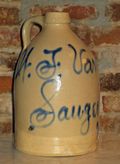
    In 1956 my father drove our comparatively new Ford from Michigan to Phoenicia, New York, a town in the Catskills known today for skiing and tubing, to retrieve furnishings stored in the attic of Grace Longyear, my mother’s first cousin once removed. Among these were a delicately painted knock-off of a Mary Gregory pitcher, a stoneware jug under whose glaze the name “William F. Van Netten Saugerties” was broadly scrawled in blue, a good deal of Eastlake period furniture, and a portrait of a handsome young man in 1820’s costume with red hair and a cowlick. The furniture was deposited in a friend’s colonial-era summer home in New Hampshire while the smaller objects and the portrait came back to Michigan with us. Jug1.1 copy
    Eight years old at the time, I loved Phoenica, whose Esopus Creek flowed behind our boarding house, and I delighted in our friends’ 1790’s home in the White Mountains, but I was less than impressed by the primitive ancestor portrait, which my mother hung proudly over our fireplace. To an eight-year-old, adults come in two categories, grown-up or elderly, so neither the man’s vibrant youth nor his good looks registered with me. Handsome was Tab Hunter, not this austere man with his haughty pose and black suit. The painting’s black frame together with the fact it had never been cleaned, despite years spent in the company of wood, oil, and candle smoke, made it downright gloomy. I named it “Jarvis,”* which seemed to capture the man’s antique austerity. My mother was mildly chargrined by my lack of respect for her ancestor, but both my father and sister took secret delight in my cheekiness, and the name stuck.                                              

    My mother tended to make us all a little crazy with her "heirlooms."  Decades later I finally understood why people of my grandmother's era thought so highly of “heirlooms” (as opposed to simply “antiques”). Heirlooms separated that generation from the immigrants flooding into the country at the turn of the 20th century. Heirlooms meant your family had been in America for a long time, had founded the country and its traditions.  My mother grew up under that tutelage, and, although I doubt she thought in exactly those terms, she was proud of her family, its colonial origins, and its heirlooms. The rest of us remained somewhere between bemused and skeptical, however.  My father was the son of those very immigrants my mother’s family wished to distinguish themselves from, and we children were Mid-Westerners with scant regard for coastal mores.  Hence: Jarvis.

    Years passed, and Jarvis rotated in and out of his post above the fireplace as my mother acquired additional art she wanted to display there. My sister Gretel and I grew up, left home, and thought little about him until we came upon the painting stashed away in the front room closet when we cleaned out my mother’s house in 2000. Gretel, who still lived in Michigan, claimed it, had room to hang it and the money to have it cleaned and restored. With close to 200 years of dirt removed, the painting glowed, and fifty years gave me a different perspective on this handsome, rather sensuous young man with his flamboyant red hair. We both agreed that Jarvis was a dead ringer for our cousin Ted, my mother’s nephew, who had the same red hair, blue eyes and cowlick. The man was definitely an ancestor; no one had to convince us of that.

    Ted2


                                                                         Theodore Story, Jr. "Cousin Ted"


    The art restorer who handled Jarvis judged the painting to be worth around $2000 but suggested it would have greater value if we could find out more of its history. For close to a decade we talked about taking Jarvis back to the Hudson Valley, but I was overwhelmed with work on our newly purchased Mill Brook House, and we kept putting off the research trip. Finally, in 2013, I agreed to go. Studying a genealogy chart Cousin Ted had given me, I determined that the painting had nothing to do with the Longyears, despite having been in Grace’s attic, and suggested we start in Saugerties, where our grandmother Isabel had grown up, a Hudson River town at the mouth of the same Esopus Creek that flows through Phoenicia. An amateur ancestry specialist in Saugerties guided us to the graves of our great-great grandparents on both sides of our grandmother’s family, the Cornwells and the Van Nattens, all born in the late 1820’s or 1830’s, none old enough to be Jarvis, who, judging by his costume, had been born c. 1800.                                                                                                                                                                          

    Discovering who had painted Jarvis proved easier, however, than finding out who he was. Observing a photograph of the painting, the ancestry specialist suggested it might be by Ammi Phillips, a highly collectable Hudson Valley folk artist working at the turn of the 19th century, who never signed his work. A curator at the Albany Institute of History and Art confirmed her suspicion, ushering us into the museum’s storage area and pulling out a panel hung with Ammi Phillips portraits for comparison. Even the frame and texture of the linen on which Jarvis was painted bore a striking resemblance to those in the Institute’s Ammi Phillips collection. A curator at New York’s American Folk Art Museum declined to authenticate the painting on the basis of a photograph but confirmed off the record that Jarvis was indeed by Ammi Phillips. Skinner, the Boston auction house, had no doubts about the authenticity and accepted the painting for its late summer Americana auction. Gretel drove Jarvis to Boston in June, and his face appeared on the cover of the Skinner catalogue. Steve and I attended the August event and watched him sell for over $30,000. The auctioneer gave me a big hug: my 15 minutes of fame.  I telephoned Gretel with the good news.                                                                                                            

    Auction1 copy

    Jarvis on the auction block

    But who was Jarvis?  And how did he come to be in Grace Longyear’s attic?

    The Longyears were related to my mother’s family by marriage, not by blood, so, given the resemblance to Cousin Ted, Jarvis could not have been a Longyear. Grace’s mother, Mary Cornwell, was my great-grandfather’s sister. It’s possible that Mary Cornwell owned the portrait and passed it down to Grace, but why would Grace have passed it on to my mother when she had children of her own who might have inherited it, and why would it have been stored with other things that had apparently belonged to my mother’s family?  

    More likely the portrait had belonged to Grace’s uncle, my great-grandfather, and his wife, Ella Van Natten. Ella survived her husband by twelve years and, at some point in those twelve years, moved to Phoenicia, where she died. It’s not clear whether her own family, the Van Nattens, had relatives in Phoenicia, but her husband had two sisters, Mary and Jennie, living there, and letters indicate that both Ella and her daughter, my grandmother Isabel, spent considerable time in Phoenicia even before Ella’s husband, Theodore Cornwell, died.
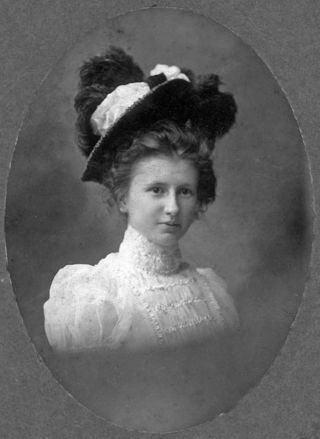
    Young Isabel copy

    Isabel May Cornwell, also a red-head, was popular with a lively group of friends who gathered in Phoenicia.

    If people in that era were proud of their families’ long tenure in America, those of Dutch descent were especially proud. The Dutch East India Company had explored and settled the Hudson Valley before the Pilgrims landed in Plymouth and controlled it until defeated by the English in 1664. Kingston and Saugerties were in the heart of those early Dutch settlements. Even in my own childhood, the significance of being a Van Natten or a descendant was a point of comment if not outright pride. For Ella, being a Van Natten was no doubt immensely important.

    Ella’s mother Ervilla Scott, wife of William H. Van Natten, lived with Ella and Theodore Cornwell from 1907 until her death in 1918 and would have brought things she deemed precious along with her.  My guess is that when Ella moved to Phoenicia, she took as much of her family’s legacy with her as she still possessed. That included silver spoons inscribed with “Van Natten” and the “Van Netten” [sic] jug. The Jarvis portrait may well have been part of that same legacy. (The jug is inscribed with the name of Ella’s brother, William F. Van Natten, who pre-deceased her in 1914. He probably commissioned it for his business, though why the name was misspelled is as great a mystery as Jarvis’s identity.)

    Margaret1 copy

    My mother with her grandmother, Ella Van Natten Cornwell, 1936

    Quite likely, Ella knew Jarvis personally or at least knew who he was. Born c. 1800, he belonged to her grandfather’s generation. Ella’s father William H. Van Natten was born in 1832, so Jarvis could have been his father. He could as easily have fathered Ella’s mother Ervilla Scott, who was born in 1837, or Ella’s husband’s father Charles Edwin Cornwell, born 1829, or his wife Jane Williams, also born in 1832. Possibly he was an uncle rather than father to any of these four people. But that he was related to one of them seems certain.
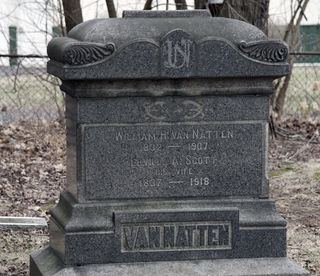
    VanNatten
        The Van Natten grave monument in Saugerties. This side bears the names of William H. and Ervilla.

    Our failure to identify Jarvis is not the only unfortunate aspect of this otherwise happy story. A year after our trip to Saugerties, Gretel’s health began to fail, and she died in January 2015. The loss was devastating, but I was so very grateful that I had finally agreed to the Jarvis trip two years earlier. We could not know it would be our last trip together, but how appropriate that it connected us to our ancestors from our mother back to our great-great grandparents and to Jarvis himself, whoever he was.


    *The nickname we gave our painting is not to be confused with the painter John Wesley Jarvis, who lived and worked at approximately the same time as Ammi Phillips.
  • Us-1795

    The War of 1812 was unpopular with men of commerce, which included prosperous farmers in the hilltowns of Western Massachusetts. In July of 1812, the town of Heath—Charlemont’s northern neighbor—passed a resolution stating that “the declaration of war against Great Britain was unnecessary, impolite and ruinous….” (Of the many resolutions passed by Massachusetts towns against the Iraq War, one has to wonder if any contained the word “impolite.”)

    The haves, who opposed the war, were Federalists, and the have-nots, who supported President Jefferson, were Democratic Republicans.  In Colrain, which borders Heath, subsistence farmer Amasa Shippee, a Democratic-Republican and a Baptist, conceived the idea of raising an American flag to express his faction’s patriotism. His wife and several other women volunteered to make the flag, although none of them had ever seen one. Amasa, who had drilled under Old Glory in a local militia, drew them a pattern, then set about felling trees for a pole.  At the time, a stripe as well as a star was added for every state, so the flag had fifteen of each.

    When all was ready, a group of neighbors, about 10-12 families, gathered to watch the flag being raised over the local schoolhouse, the first American flag ever raised over a public school. That night, however, a group of Federalists used an augur to silently bore holes in the flagpole until it toppled over.  The pole remained where it fell, but no one knows what happened to the flag. 

    This was the war in which Francis Scott Key celebrated the survival of the "Star-Spangled Banner" under enemy fire, putting it on course for the fetishistic treatment it receives today. But the national symbol that survived British bombardment did not last one day in Colrain! Truly, we are our own worst enemy.      

  • Fiestaware


    Observing my china cabinet, a friend who knew my mother once observed that I had inherited her love of dishes. It’s not as though I never met a dish I didn’t like, but I do like far too many. Sifting through all the dinnerware suddenly available to me at Mill Brook House, it seems sad to give up the “Monticello” Hall China—soft white with a rim of tiny flowers—bought for the house for $5 at a rummage sale and replace it with our elegant Dansk plates from the condo, and, as usual, I wonder how much of my mother’s formal Noritake—white edged with gold (and 12 of everything!)—I will ever use again.

    This causes me to reminisce about my mother’s own journey through dishware. Until I was nine, we ate off Fiestaware. Introduced to the market in 1936, it was rapidly becoming outmoded in the course of the 1950’s. Then a miracle happened which would forever alter our lives and our dishes: my father, through Michigan State University, accepted a Defense Department contract to mentor and teach at the University of Ryukyus in Okinawa. Unlike most of the military personnel stationed there, my parents found the island and its culture—Japan’s fused onto an ancient local folk culture—immensely fascinating, so much so that they spent every weekend driving around the island, visiting small villages and combing the beautiful beaches. Because the island remained under American military occupation, it had Japanese goods, sold in local shops, but no Japanese industry or tourism, no hotels or large chain department stores, and only one highway (Highway 1, of course), which petered out somewhere beyond the large air base in Kadena, about 18 miles north of the capital city Naha.

    Although the Army generously shipped household goods around the world for its soldiers and civilian employees, my mother was only too happy to leave her outmoded Fiestaware behind. Instead of replacing it with whatever the Post Exchange (PX) had on offer, however, my parents, charmed as they were by the local culture, bought mountains of cheap Japanese dishes, available throughout the island in dozens of small shops dedicated to selling all the varied dishes required for a Japanese meal. Among these were dinner-sized plates, presumably intended as serving dishes, which my mother adopted as our new dinnerware. The plates had a soft, blue-green glaze with cranes and pine, symbols of good fortune and longevity, placed asymmetrically to one side. The only problem? They were not flat, and American cuisine at the time still dwelt primarily in meat-and-potatoes-land. Whenever one tried to use a knife and fork, the food on the far side of the plate was inclined to springboard up and hit one in the face.

    Nonetheless, my mother never went back to her Fiestaware, even after returning home to Michigan. We endured those Japanese plates until our next sojourn in Okinawa when she purchased a more suitably designed stoneware, which had recently come into fashion, at the PX. Her Noritake, too, was purchased there during this second tenure. The Fiestaware lived in the basement for many years, but by the time it came back into fashion in the 1980’s those original plates had disappeared, probably donated to a cache reserved for MSU’s foreign student families. But that’s okay. Athough it evokes fond memories, Fiestaware was never really my taste, either.  


  • JS6 copy

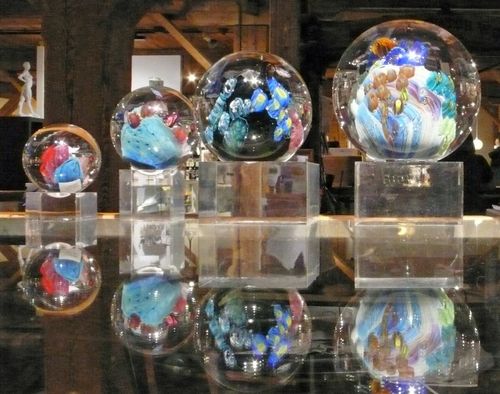
    Apart from Bill Cosby, whose reputation has suffered recently, our most famous local resident is probably glassmaker Josh Simpson. I first encountered Simpson’s work years ago at the Peabody-Essex Museum in Salem, which owns one of his “megaplanets.” A Simpson “planet” is a spherical ball with shapes inside made with a variety of techniques and an abundance of glassmaker’s “cane” (similar to a glass version of candy cane, sliced up to reveal intricate patterns).   The planets evoke other worlds—Avatar-land or underwater seascapes—without actually depicting identifiable forms. A “megaplanet” is a large planet, a 4.5 diameter counts as a megaplanet, but Simpson has made several weighing over 100 pounds.

    Planet3.1 copy

    This megaplanet weighs 111 pounds

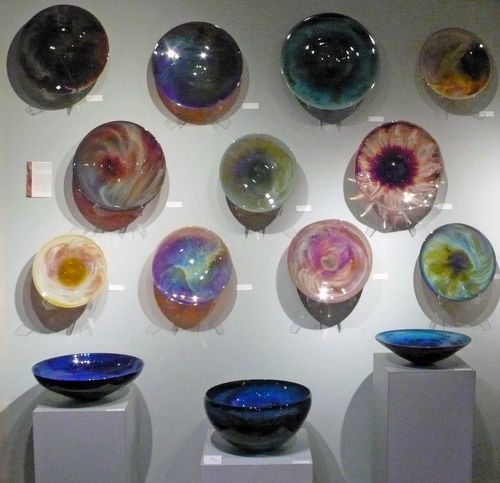
    The Peabody-Essex also owns a very large plate by Simpson in what he calls New Mexico glass. Inspired by southwestern night skies, these large, dark blue plates and bowls, as simple in their colorscape (if not their execution) as the planets are lively and complex, invite meditation.

    Plates2.1 copy

    A wall of Simpson plates at the Salmon Falls Gallery; New Mexico glass bowls sit beneath.

    I was instantly smitten with Simpson’s work and always sought out the megaplanet whenever I visited the Peabody-Essex. When we moved to Western Massachusetts a decade later, I was thrilled to discover we were living in fairly close proximity to this master craftsman.

    A psychology major, Simpson discovered glass blowing while an undergraduate and never looked back. His work is featured in many galleries and major museums including Boston’s Museum of Fine Arts and the Corning Glass Museum, which commissioned the first 100-pound megaplanet. In 1997 Simpson married future astronaut Catherine “Cady” Coleman, at this writing a space shuttle and International Space Station vet, who has logged over 4000 hours outside planet Earth.

    JS5 copy

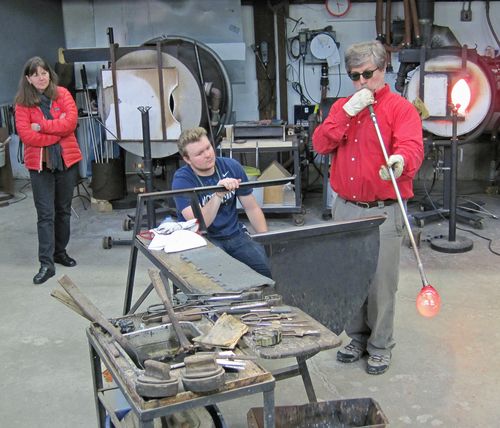
    Simpson blows glass while Cady Coleman looks on

    We recently attended a rare open studio at the Simpsons’ mountaintop establishment in Shelburne. Josh talked while he demonstrated his techniques and introduced Cady, who was between a baby shower and a soccer game, having just spent the week criss-crossing the world on NASA business. Meanwhile, I purchased a paperweight planet and a signature blue plate—similar to but much smaller than the objects I first fell in love with at the Peabody-Essex—purchases I could never have afforded at Simpson’s Salmon Falls Gallery in Shelburne Falls. The gallery is magical, however; walk in and you’re surrounded, enveloped really, by this glass artist’s amazing creations.

    Planet2 copy

    A row of gradated planets at the Salmon Falls Gallery

    Photographs by Steven Sternbach

    For more on Josh Simpson, see this article in The Recorderhttp://www.recorder.com/One-of-a-kind-glass-planets-keep-trade-fresh-for-glass-artist-Josh-Simpson-16674820

  • I came around the corner of the house and stopped.  A young bear, shiny and slender, a perfect ingénue, was crossing the road.  She hung in the middle for a moment as she turned back for one, two, three (!) reluctant cubs, who came tumbling out of the underbrush and followed her across the road from the mountain on the Hallenbeck property to the streambed on ours.  Everyday, my neighbor tells me, the bears cross back and forth from our property to his, sometimes in front, sometimes in back of our houses.  Seeing them is serendipitous—looking up or looking out on the correct side of the house at the exact, right moment.  In mid-September I looked out in time to see one of the cubs, three times as big but still a roly-poly bundle of fur, bounce across our backyard.  Was he on his own or had the others preceded him moments before?  No way of knowing.

    Bear2
    Yearling bear, Mohawk Trail State Forest 

    And so it is with all nature encounters at Mill Brook House, although our chances of seeing wildlife seem greatest when mothers are tending to babies. One April, as we were working with a friend and his tractor to remove some trash from our front woods, we almost stepped on a nesting woodcock, who blended in perfectly with the forest floor and never budged from her nest, despite the tractor operating no more than six feet away.  We returned later that afternoon with a camera, and some weeks later I determined that the eggs had safely hatched. 

    Woodcock
    Woodcock on her nest

    Another year, in early June, we flushed a doe from our back meadow and subsequently discovered the reason she had let us get that close: a large brown patch near our mowed path turned out to be a newborn fawn.  We took pictures while Mama skulked in the back woods, moving from shadow to shadow but never leaving.  Newborn fawns have no scent: our dog Nellie, with us on a leash, never noticed the baby lying three feet away.  Only later in the afternoon, when our house fell completely quiet, did the doe move her fawn to a less conspicuous location.

    Babydeer
    "Kinda wobbly, ain't 'e?" 

    The opportunity to photograph a deer close up comes rarely, but we nevertheless witness fragments of deer drama from the house, never quite knowing the beginning or the end of the story.  One year, three fawns played in the tall grass in the front meadow day after day, ignoring me painting on the porch and men working  on the roof.  Some days their moms joined them and one day moved them on.

    Fawn2
    Fawn in the front meadow 

    Pregnant Deer

    A pregnant doe checks out the back meadow

    In the same spot at the end of the back meadow where we found the baby deer, Nellie flushed a mother turkey, who, it turned out, had been hiding with her babies.  Each of what of I subsequently learned were sixteen or seventeen chicks, was individually wrapped, dug into its own little nest of grass and completely invisible.  Although already starting to sprout their black feathers of adulthood, they could not yet fly.  Three weeks later, when Nellie flushed them from the back of our woodpile, over a dozen black, gawky teen turkeys flew up into the nearby trees.  Mama fled across the small brook that partially encloses our back field, and eventually they joined her. 

    Baby turkey2
    Wild turkey chick

    Every spring phoebes nest under the eaves, and yellow-bellied sapsuckers pound on dead trees to attract mates and announce their territories.  More quietly they build nests, raise young, and soon our trees are full of pint-sized little sapsuckers.  Hawks and hummingbirds also nest in the nearby woods, while song sparrows, chipping sparrows, and common yellowthroats, cheeky, black-masked warblers that scold prodigiously from low branches when we come too near, nest in the tall impenetrable weeds near our mowed paths.  One year neglect allowed the weeds in my lupine garden to get so thick that the yellowthroats found it an ideal nursery.  Gardening one day, I discovered the babies running through the lupines.  Like the parents, who fly up from their nest to perch on low tree branches, the chicks instinctively hopped up on the sturdy stems of the lupine leaves, where I caught them with my camera.

    Common.yellowthroat
    Common Yellowthroat chick 

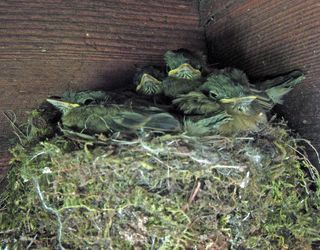
    Less serendipidous are the babies born regularly in our birdhouses or under the front porch.  After Hurricane Irene, the phoebes moved.  Did they have a nest with young when walls of water from the misdirected brook slammed against the back of our garage where they had nested for a decade or more?  In any case, they moved to the front and took up residence under the front porch.  That put them at eye level, and the first year they freaked and abandoned the nest but returned to the same spot the next summer to try again.  They fussed and fidgeted when we came near, but stayed to raise two broods.  The following summer they were back….

    Big mouth2
    Phoebe nestlings

    Phoebes2
    Ready to fly 

    Every year bluebirds and swallows battle it out for the birdhouses.  Fortunately, the bluebirds get a headstart, but the swallows are agressive and often take over at least two of the three nest boxes.  One of the houses can be opened in situ, which permitted me to snap this photo of a surprised youngster almost ready to fledge.

    Babyswallow
    Baby tree swallows


    2015: Once again we have a bird nursery with bluebirds and swallows in the bird houses, goldfinches, cedar waxwings, yellow-bellied sapsuckers, indigo buntings, common yellowthroats, hummingbirds (and no doubt many other species) hatching babies in our woods.  Baby turkeys accompany their parents from open field to open field throughout the neighborhood, and a yearling bear made its way across our lawn from the neighbors’ apple trees (and barbecue pit).   Twice this spring we’ve surprised mother deer with still scentless fawns and watched the mamas bound off while the babies lower themselves to the ground, where they remain completely motionless, though wide awake.

    Fawn3
    This fellow wanted to run but couldn't keep up with mom; he left to join her as soon as we went inside.  

    Each year the magic repeats itself, and each year we wait to see what new delights spring and early summer will bring.   


    (all photographs copyrighted by Steven Sternbach and Kathe Geist) 


  • We spent most of Saturday, June 20, celebrating Charlemont’s 250th birthday.  State Representative Paul Mark and Senator Benjamin Downing presented the Town with a framed facsimile of its original charter, which the two men had paid to have restored.  Five towns in Downing’s district had 250th birthdays this weekend, so the senator was busy.  I asked if they financed restored charters for all of them, and Mark replied that this was only the third he’d ever done; not all town charters need restoring and/or not all are restorable.

    CharlCharter_edited-1
              State Sen. Benjamin Downing and Rep. Paul Mark with members of the 250th Anniversary Committee presenting the Town's restored Charter in Charlemont's Federated Church

            Incorporated in 1765, two years after the end of the French and Indian War had made western settlement more attractive, Charlemont was already hostile to British rule.  Attempts to limit westward expansion no doubt rankled, and the distinctly American culture that had emerged in the colonies by then was even more pronounced in Western Massachusetts than along the coast.  A tradition of radicalism still permeates the region today with Western Mass in the vanguard of “liberal Massachusetts'" liberalism. 

                After lunch with Downing and Mark, which ended with a surprisingly delicious chocolate birthday cake baked for the occasion, we toured Charlemont’s historical museum, where we found a picture of our house c. 1900.  (More on that to follow in a later post.)  In the afternoon we headed to a pick-up softball game at the Hawlemont Elementary School and a picnic dinner, accompanied by the delightful Small Change, a country/swing quartet featuring our General Store proprietors, Dennis Avery and Karen Hogness, both talented musicians as well as dedicated shopkeepers.

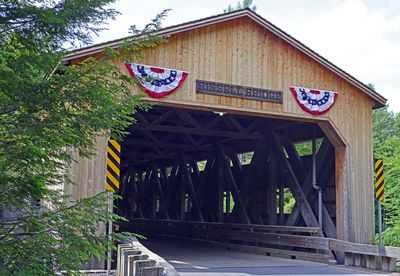
                Festivities continue all summer, especially the weekend of Yankee Doodle Days, July 24-26, when, along with the fireworks and other attractions, there will be a special 250th celebratory parade.  A special Bissell Bridge dedication with potluck supper and square dancing is scheduled for September 26.  (This particular celebration was supposed to happen six years ago when restoration of the bridge was completed.  However, before the party could happen, a tree fell on the bridge, putting a hole in the new roof, and by the time it was repaired, a year had elapsed and enthusiasm for the party had waned.)

    Bridge2
    The Bissell Bridge dressed up for the 250th Anniversary

                We’ve made new friends this weekend and learned more about our town’s history.  I have been particularly struck by the number of times historic landscapes and even traditions like Yankee Doodle Days have been allowed to fall into disuse or disrepair, only to be revived by later generations.  The 2009 restoration of the Bissell Bridge, which had been out of commission for 17 years, is one recent example. 

               At 250, Charlemont is looking to both the past and the future.  The Hawlemont Elementary School, established in 1953 to serve both Hawley and Charlemont after the last of the one-room school houses had closed, has introduced a new agricultural program in an attempt to support the region’s revived interest in farming.  At the same time, a battle to bring in a fiber optic cable network is being waged by residents tired of DSL or, worse, dial-up internet.  Meanwhile, a new, year-round mountain coaster at Berkshire East, our local ski resort, is boosting tourism and increasing business opportunities.  A town with its roots in the French and Indian War and home to America’s first scenic highway (1914), Charlemont is looking forward even as it celebrates its past.

    HAPPY BIRTHDAY, CHARLEMONT!! 

    Cake_edited-1


    Photographs by Steven Sternbach.  For more photographs of these celebrations, the parade, and the 2015 Yankee Doodle Days, see our photo album: http://www.millbrookhousenews.com/photos/charlemont250/index.html


  • We watched Woman in Gold with about four other people last Sunday at the Greenfield Garden Cinema’s noon screening.  It tells the story of Maria Altmann’s recovery of five Klimt paintings, including the iconic “Woman in Gold,” a portrait of her aunt, which were stolen from her family by the Nazis.  Maria’s story, at least as told in cinema, is an upper class parallel to 2013’s Philomena: a young male professional helps an elderly woman right the institutional wrongs done her when she was very young.  The two criss-cross the Atlantic seeking truth and justice, and the initially shallow young man discovers his soul.  Helen Mirren as Maria is as captivating as Judi Dench’s Philomena.

    Maria’s story begins in Vienna where the Bloch-Bauer brothers, Ferdinand and Gustav, live with their wives and Gustav’s children, Luise and Maria.  The wealthy family hosts the cream of Vienna’s arts community and count Gustav Klimt and Arnold Schoenberg among their friends.  Ferdinand’s wife Adele sits for Klimt, and the portrait, with its intricate gold leaf patterns, hangs in their drawing room.  When the Nazis march into Vienna, persecution of the Jews follows swiftly, the Bloch-Bauer home is looted, and escape becomes nearly impossible.  Adele has died a decade earlier, and Ferdinand has fled to Switzerland ahead of the Nazi invasion.  Maria, now married, and her husband Fritz escape with the help of friends, but they must leave her parents behind.  After the war, art works looted from Austria are returned to the Austrian government, but not to their original owners.  In 1998 Austrian law regarding the stolen art changes, and Maria and her lawyer Randy Schoenberg (Arnold Schoenberg’s grandson) begin a quest to have some of the looted art returned.

     Among Holocaust movies, Woman in Gold stands with Schindler’s List and The Pianist as one of the best.  It has less violence than most Holocaust movies, but Maria’s confession at the end that neither the justice she’s won nor the priceless paintings she’s recovered can compensate her for having had to leave her parents behind in Nazi-occupied Austria is wrenching.  Multiplied by hundreds of thousands of young émigrés, it illustrates the anguish that haunted a generation long after the Holocaust ended.

  • With 2013 so rife with docudramas that NPR’s Robert Siegel felt the need to fact-check them, we managed to see two more over the Christmas holidays, films in which the protagonists attempt to heal relationships long severed by time and space: Saving Mr. Banks at the Greenfield Garden Cinema and Philomena at Images, a small non-profit, one-screen movie theater in Williamstown (charming home of Williams College).

    The films differ in many of the ways I cited when comparing Apollo 13 and Captain Phillips (10/21/13), with Mr. Banks far more structurally complex than Philomena, a fairly linear narrative recounting an Irish woman’s search for her out-of wedlock child, taken from her when he was three.  As part of Philomena’s story, the film informs us of the horrors of a particular Catholic home for unwed mothers (and we remember the many  exposés in recent decades of similarly abusive Irish institutions for children that thrived in the 1950s).  Flashbacks tell us how Philomena conceived and then lost her child.  Somewhat more avant-garde are the flash-forwards that seem to be Philomena’s imaginings of her son and turn out to be part of a video montage of the child’s life that his friend has compiled.  An on-going dialogue between the two main characters about the virtues and abuses of faith never fully resolves the issue, but the narrative’s many unexpected twists and turns organize the film and hold our attention 

    By contrast, Saving Mr. Banks, which tells the story of P.L. Travers’ negotiations with Walt Disney over the rights to film Mary Poppins, has a much more complex, multi-layered structure, whose over-arching theme is the redemption of all imperfect fathers through art, e.g. cinema.  Where the flashbacks in Philomena fill in the beginning of her story, the purpose of the flashbacks in Mr. Banks, which detail Travers’ rich and troubled childhood relationship with her alcoholic father, remains a mystery until the various threads of the father theme begin to coalesce in the last third of the film.   Although both Judi Dench as Philomena and Emma Thompson as P. L. Travers are worth the price of admission, Saving Mr. Banks is more artistically satisfying and, for anyone who is or has had an imperfect father—which may include most of us—cathartic and restorative.  We are moved by Philomena’s story, but Mr. Banks’s story is ultimately our own.

     Both films expand on a recent trend in docudrama—one Steve and I find delightful—of including film footage, stills, and, in the case of Mr. Banks, audio recordings of the actual historical characters in the credit roll.         

  • *Gretel4_edited-1

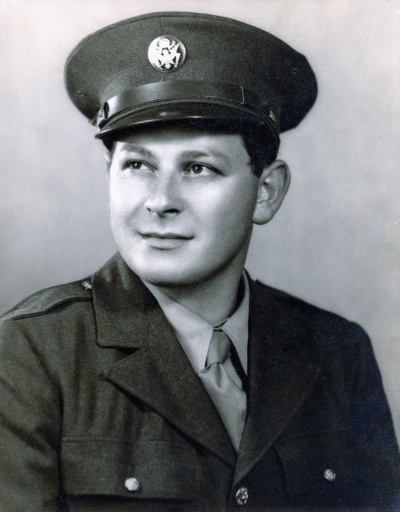
    When I asked my father why, when he graduated with his Ph.D. in 1940, he didn’t immediately begin a job search, he answered, “Because I knew we were going to war.”  Apparently that same logic applied in reverse when it came to having a baby.   With war looming, their biological clocks ticking, and the optimism of youth, my parents had a baby.  Gretel Marie was born thirteen days after bombs fell on Pearl Harbor.

      *Gretel and Mom & Dad
    Daddy's girl

    With the exception of my Uncle Walter and a few older cousins, I have known her longer than anyone living.

      *Gretel & KGretel and Kathe, March 1948

    Because of the age difference, we didn’t play together much, except on holidays…

    *K&G2a
    Christmas, 1951

    …but with our parents, we explored the Far East…

    *The fearesome threesome1_edited-2
    Okinawa, 1960

    …and the Far West together.

    *Sisters1_edited-1
    Yellowstone National Park, 1960 

    After a few false starts, Gretel would pursue a successful career in college theater as a costume designer, marry the love of her life, Frank Rutledge, and have two beautiful children, Jenny and Weldon, both of whom are ensconced today in careers that they love, married, and starting families.

    After years of watching her artwork disappear every time a theatrical production closed, Gretel took up printmaking, and, over time, explored other fine and applied arts.  Her prints were shown and sold in shows and galleries throughout Michigan.

     She visited us at Mill Brook House at least once a year, where she and Frank, who died in 2008, made many valuable contributions.  More than that she was our cheerleader, always happy to hear news of our adventures in Charlemont.  In what would be our last conversation, I told her about a bald eagle we had seen a few days before, perched in a tree along Route 2, not far from the house; her face lit up in that trademark smile we have known and loved for so long.

    Girl and Dragon2
    "Woman in the Wilderness," 2013